Familie Fiechter – Fiechter Family - Famille Fiechter
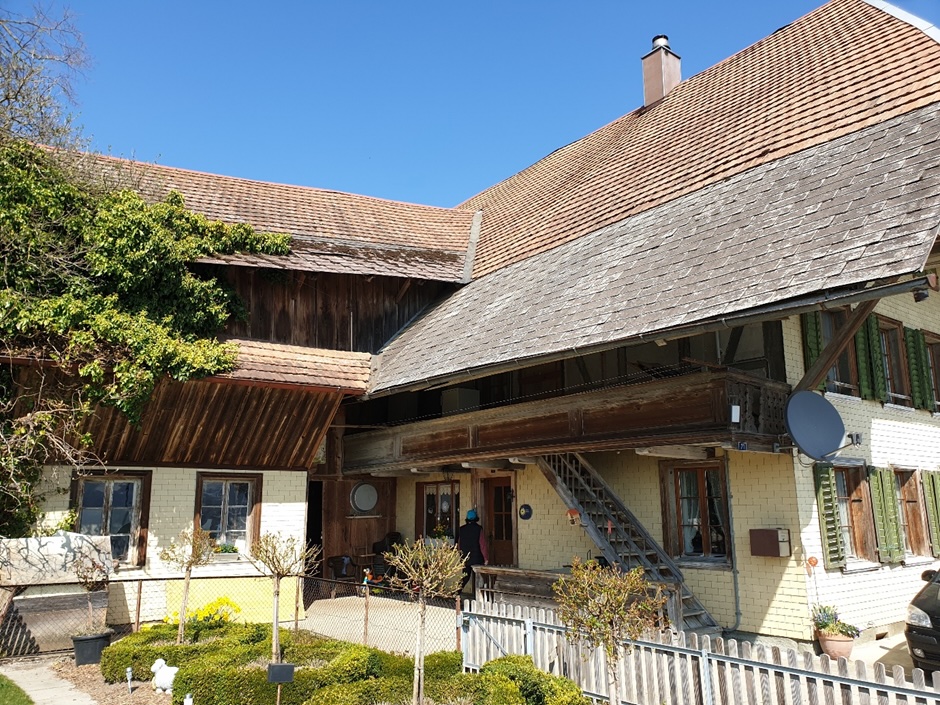
This Website is dedicated to the members of the Fiechter family originating from the Municipality of Dürrenroth in the Canton (State) of Bern / Switzerland, related to the Fiechter-Schwarz / who lived (1852 – 1937) in Huttwil, before acquiring the farmhouse at Chaltenegg / Kaltenegg ("Colt Spot"), overlooking the village of Dürrenroth.
There are other Fiechters originating in particular from Basel, but without known connections to the Bernese Fiechters.
Diese Webseite ist der Familie Fiechter gewidmet, und insbesondere den Nachkommen von Fiechter-Schwarz (1852 – 1937) / Fiechter-Bütikofer / Fiechter-Lötscher, Bürger von Dürrenroth.
Ce site internet est dédié à la famille Fiechter originaire de Dürrenroth, descendants des Fiechter-Schwarz (1852 - 1937) de Dürrenroth ainsi qu'aux descendants des Fiechter-Bütikofer qui ont vécu à Suhr en Argovie et finalement aux Fiechter-Lötscher qui ont vécu à Genève.
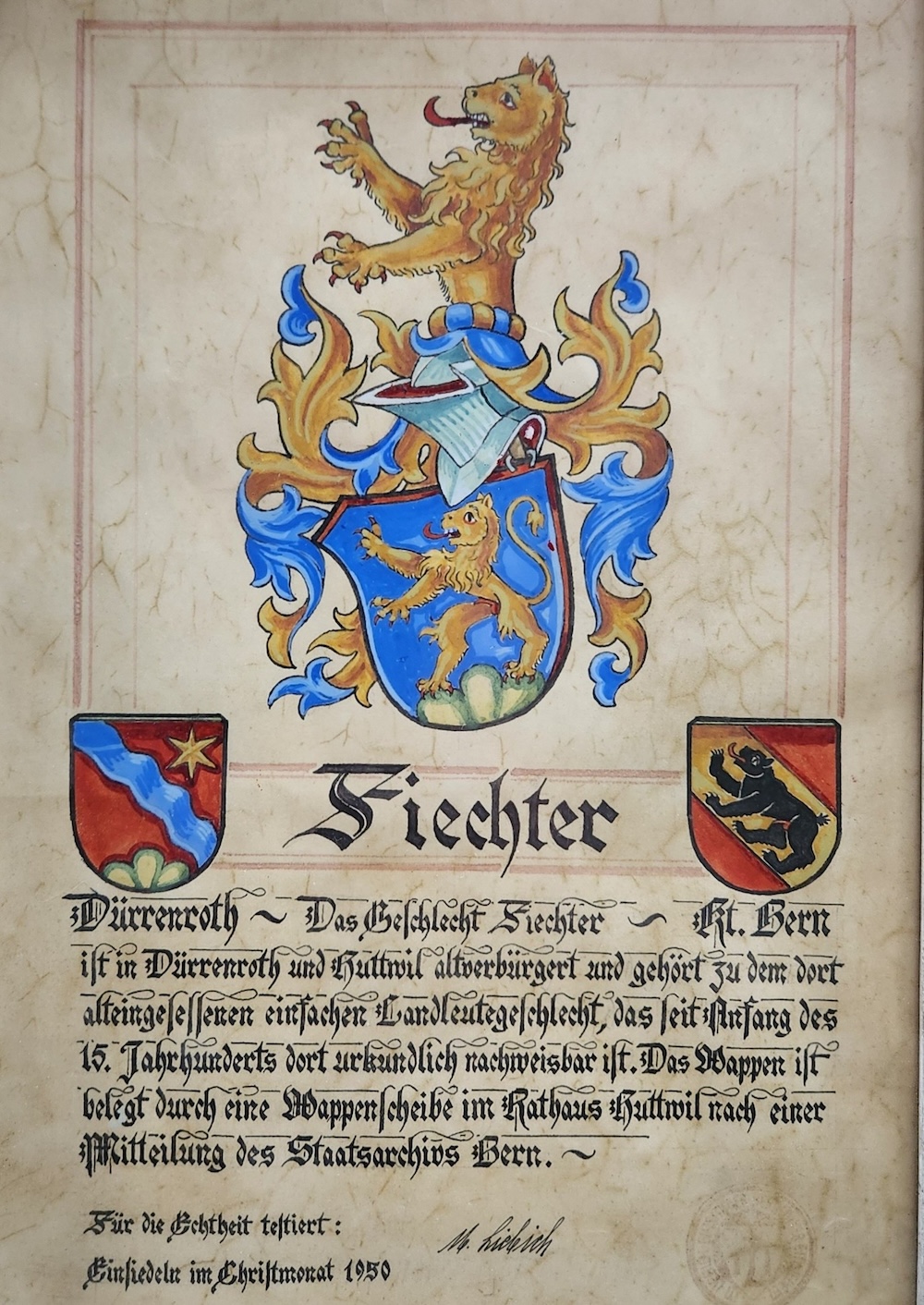
The name "Fiechter" has been known in the region of Huttwil and Dürrenroth in the canton of Bern since the fifteen hundreds, and can be found in the local archives or church records since they have not been destroyed over time, contrary to what happened in many other European areas and there are still Fiechters living in that region today!
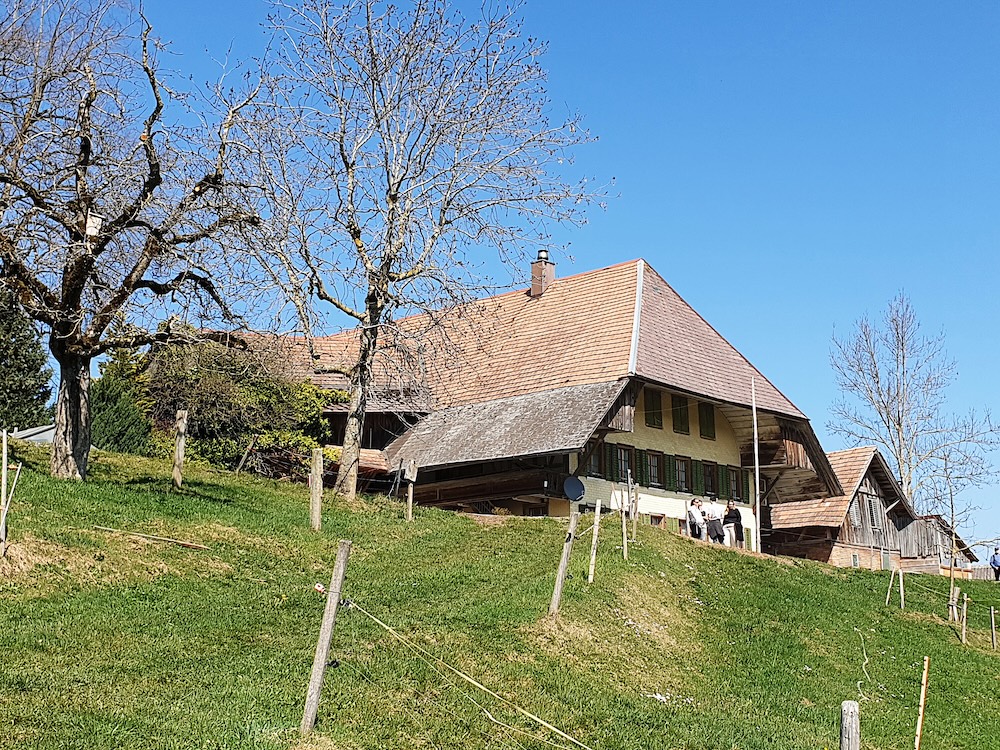
The farmhouse at the Chaltenegg remained in the Fiechters' property until the second part of the XXth century. In 2025, it is still standing there with new owners, together with two other farmhouses.
Today, traces of the Bernese Fiechters can be found in particular in Switzerland in the regions of Aarau and Geneva as well as in the city of Bern and outside Switzerland in the USA, in Canada and even in New Zeeland as in the nineteenth and first part of the twentieth century, some had to emigrate to survive because there was not enough food and work for all.
The Geography and History around the Fiechter Name
Huttwil is first mentioned in the 9th Century as Huttiwilare, and is called today colloquially Huttu. Huttwil was probably first settled in the 7th or 8th century, though it first appears in historic records in the 9th century. The village church is first mentioned in 1093 or 1108 in connection with Berchtold II von Zähringen, the ruler of that region. In the 14th century, Huttwil came increasingly under the influence of the City of Bern.
In 1528 the City of Bern adopted the Protestant Reformation and Huttwil converted along with the rest of the Bernese territories and possessions. To this day, the bigger church in any village or town of the region is usually the protestant church. The Anabaptists and Mennonites had to leave the area due to the persecution in the 16th century.
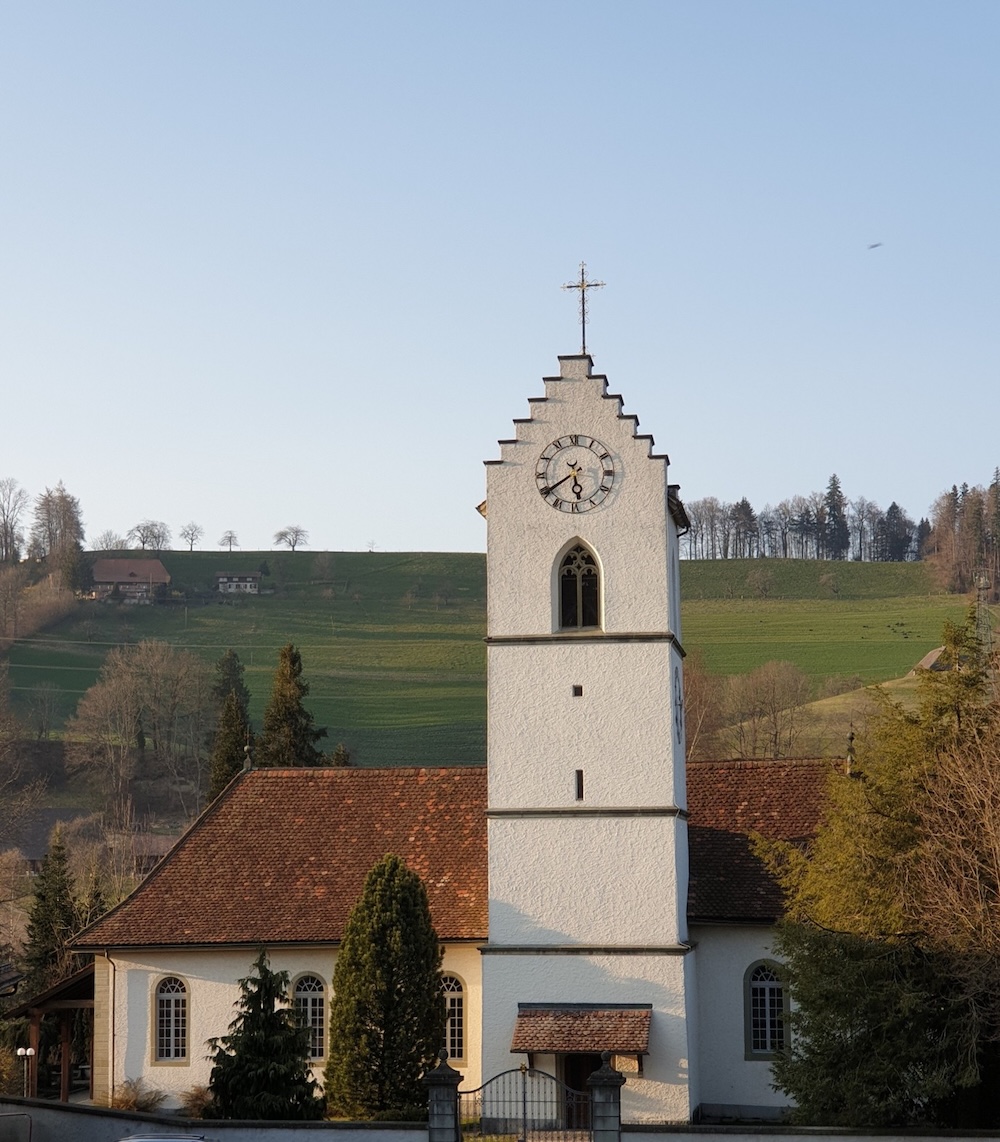
The region had an increased number of rich farmers, which is obvious when one looks at the size of the farmhouses. The farmhouses are much bigger than those of the neighboring state of Lucerne. The youngest boy in the family normally inherited the farm house, since that is when the parents had reached retirement age, i.e. the age to transfer the farm to the next generation. The other boys traditionally learned a trade and then left the farm.
During the French revolution Switzerland was invaded and the French reorganized Switzerland as a republic "the Helvetic Republic" but after four years (1798-1803) the states/cantons were restored and a few years later the old Swiss Confederation of sovereign states became a federation of self-governing states by the adoption of the first federal constitution in 1848. Even if it is still called today Helvetic Confederation of 26 sovereign states it is actually a federal state. But the memory of the old confederation is still alive, reason why the name and the description of Switzerland was not changed in the year 2000 when the new federal constitution was adopted.
Throughout the 19th century a number of factories and small shops opened in Huttwil, including canvas weaving, spinning wool, horsehair spinning, knitting mills, tanneries, sawmills and furniture manufacturing.
Today the manufacturing sector in Huttwil provides about one-third of all jobs in the municipality. The adjacent Dürrenroth is a small municipality, known for its picturesque rural landscape, traditional Bernese architecture, and close-knit community. https://en.wikipedia.org/wiki/D%C3%BCrrenroth
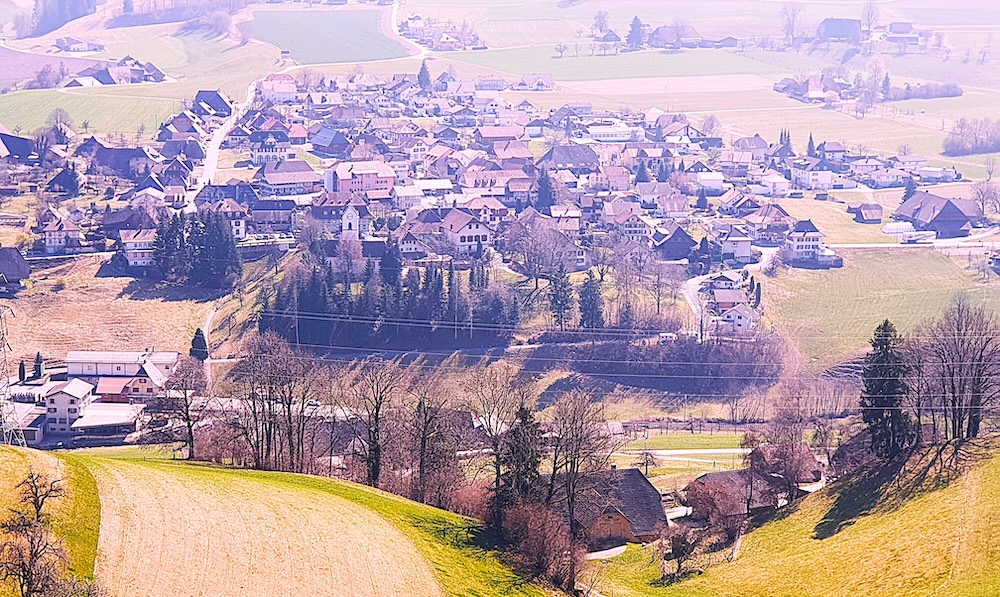
The name "Dürrenroth" is thought to be derived from "Dürren" (dry) and "Roht" (cleared land) to make it suitable for agriculture. The river below the village is the Rotbach (Red Stream). The children who lived in the farmhouses of Kaltenegg or Chaltenegg went to school to the neighboring municipality Rohrbachgraben because it was nearer.
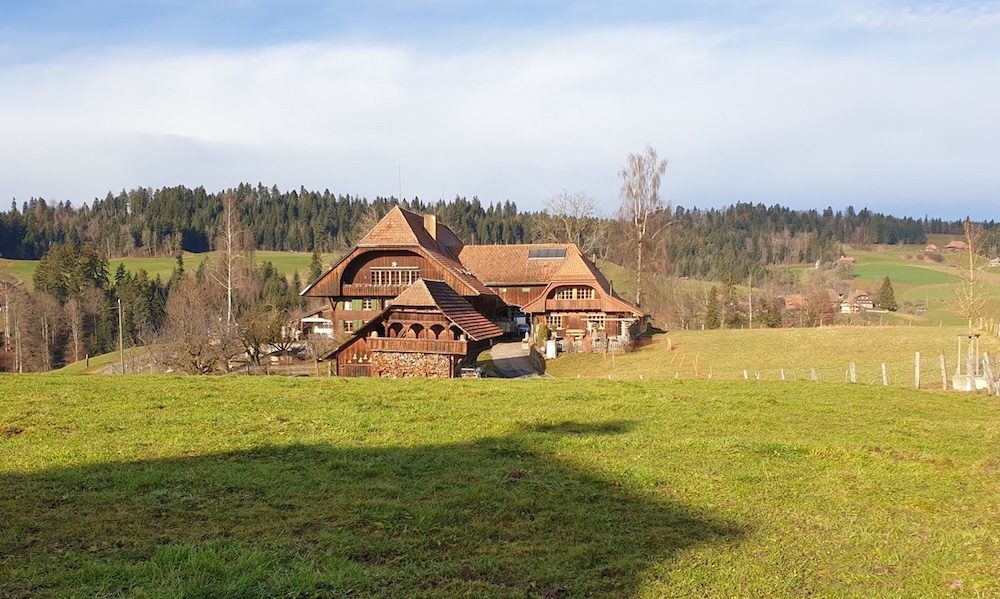
Dürrenroth, like many other villages in Switzerland, has experienced gradual urbanization and is now part of the Emmental District, an area known for its dairy production, including the famous Emmental cheese.
The idyllic landscape we can enjoy today was famine-stricken in the past when the farmers could not grow potatoes because of a too wet season or similar meteorological issues. This contributed to a mass exodus until the middle of the twentieth century, when the families became much smaller. This is why Dürrenroth had not grown during the last two centuries.
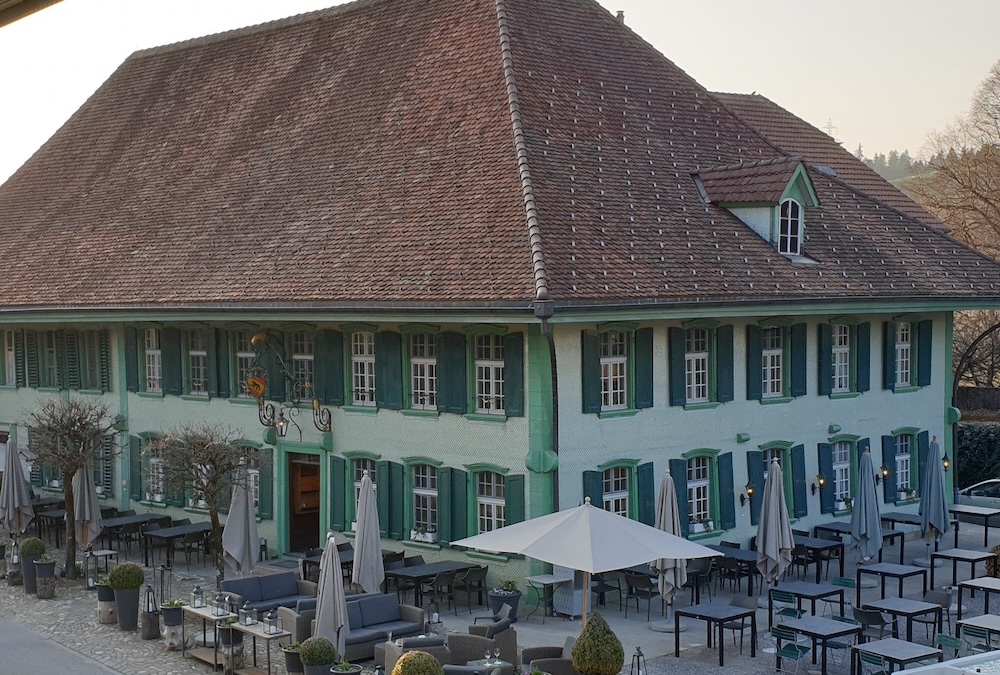
The village of Dürrenroth has a fine hotel and restaurant. They existed already in the nineteenth century and merged in the XXth century. They are now rather high-end establishments https://www.baeren-duerrenroth.ch/en/couple-and-family-activities, ideal for a wellness retreat or for a family meeting. Gwendoline Fiechter celebrated her 40th birthday there.
The nearby Spittel Castle, also known as Sumiswald Castle, is a former castle of the Teutonic Order in Sumiswald, Canton of Bern, Switzerland. It inspired the tale of the Black Spider by Jeremias Gotthelf. The tale is an allusion to the excessively hard work required from the farmers of the region to build the castle leading to famine due to insufficient time to take care of their fields. The resulting poor health may have contributed to make the big pest epidemy so deadly. It decimated 2/3 of the villagers of Sumiswald – Covid in our time was nothing in comparison.
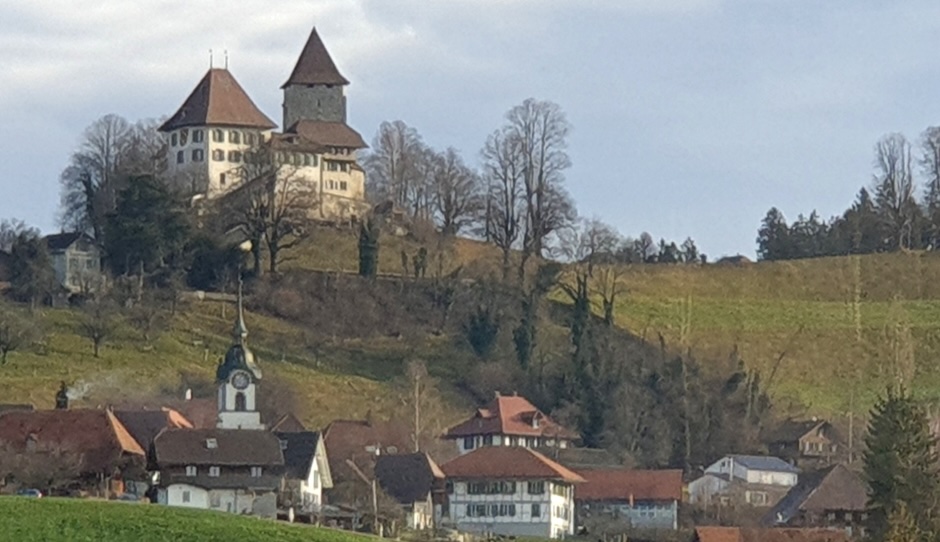
The castle still stands not too far away from the village of Sumiswald. It was donated in 1225 by Lüthold von Sumiswald to the Teutonic Order with the stipulation that a hospital should be set up there - hence the name Spittel (Spital in German). In 1673 the Teutonic Order offered to sell the structure and the rights linked to the castle to the City (state) of Bern. The sale was finalized in 1698 and from then on, Sumiswald belonged to Bern. From 1698 to 1798 the castle was the seat of a Bernese bailiwick and in 1812, after the turmoil of the French Revolution and the invasion of Switzerland by the French troops, ownership passed to the municipality of Sumiswald. The castle, rebuilt on behalf of the state of Bern after the fire of 1730, housed a retirement home until the end of June 2016 and has since been used by the municipality for various purposes.
This region was connected to several railway lines. The Langenthal–Huttwil railway opened in 1889, followed by the Huttwil–Wolhusen railway in 1895 now part of the Lucerne suburban network, the Ramsei-Sumiswald line opened in 1908 and the short branch line from Huttwil to Eriswil in 1915 (dismantled in 1978). The railway companies eventually merged into the United Huttwil Railway (Vereinigten Huttwil-Bahnen), which in 1997 became the Regionalverkehr Mittelland AG, which in turn was integrated into the BLS Railway company. The line between Wasen - Sumiswald and Huttwil, serving Dürrenroth, is operated since 2013 by the local company https://emmentalbahn.ch/ running historic steam and electric trains on the line when it is not used for testing purposes by the Swiss Railway manufacturer Stadler or by other Railway enterprises https://unter-emmentaler.ch/news-details/leman-express-auf-emmentaler-schienen.html.
The Fiechter Farm on top of the hill is overlooking the railway line Ramsei – Huttwil. https://de.wikipedia.org/wiki/Bahnstrecke_Ramsei%E2%80%93Huttwil
Christian and Anna Fiechter (BE) (XIX century)
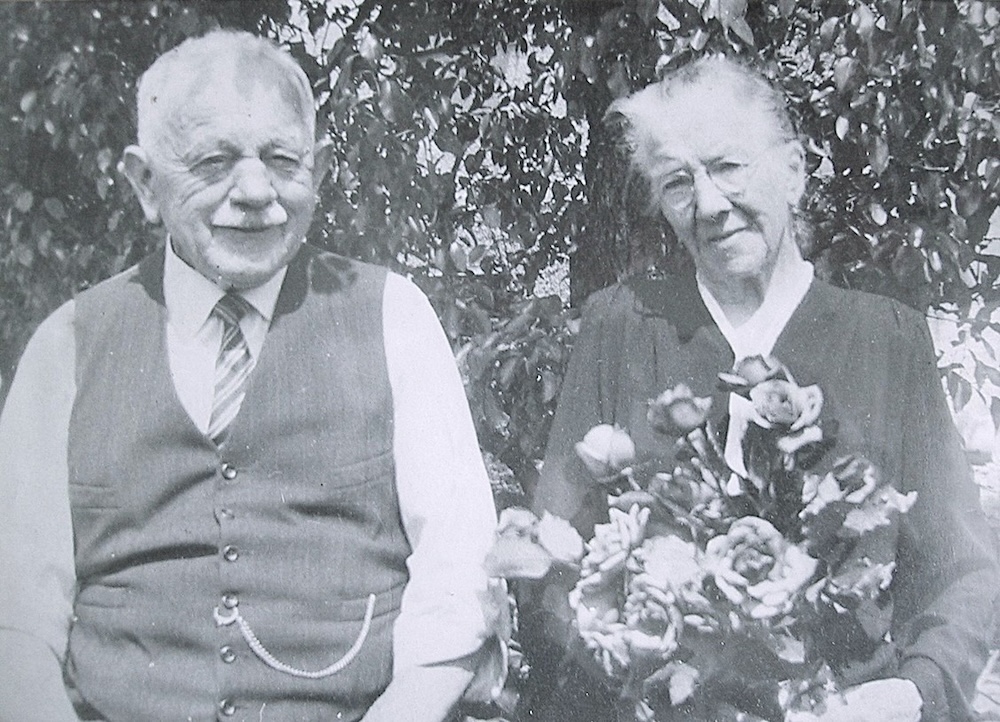
The oldest pictures we have about the Fiecher Family are with Christian Fiechter (21.04.1852/11.12.1937) and his wife Anna Fiechter-Schwarz from Lauperswil (26.06.1856/12.05 1934). They lived on the Chaltenegg in Dürrenroth, but it seems that, besides being a farmer, Christian served also as Justice of Peace in Huttwil, the first of the family to be involved in the administration of justice.
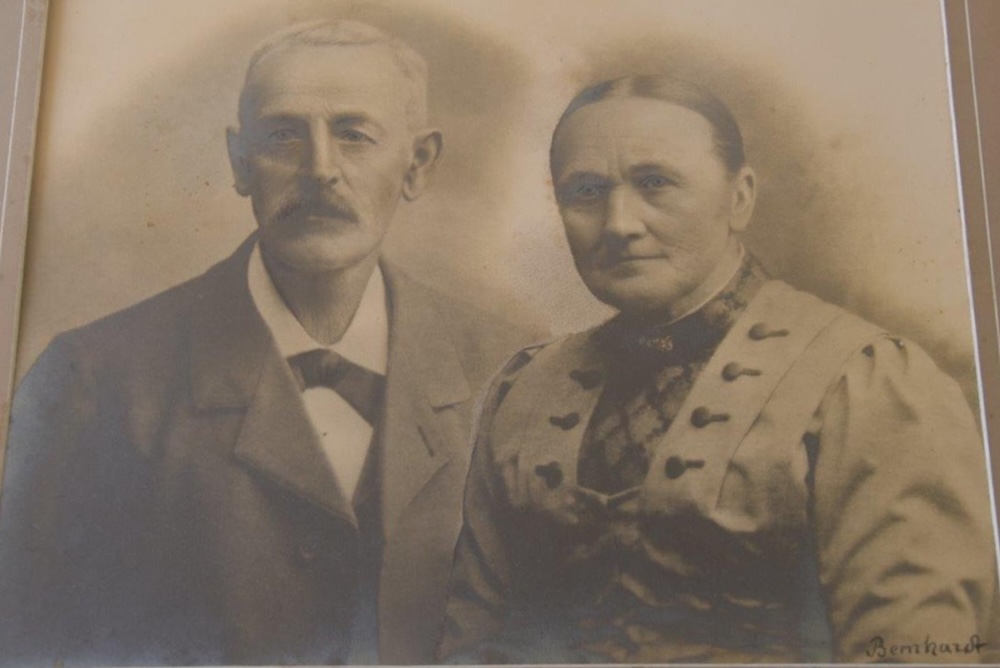
Christian had an amazingly long life, much longer than the average life at his time, with 85 years. His younger wife died before him, but at 82, she had also a long life, with so many children over only 20 years.
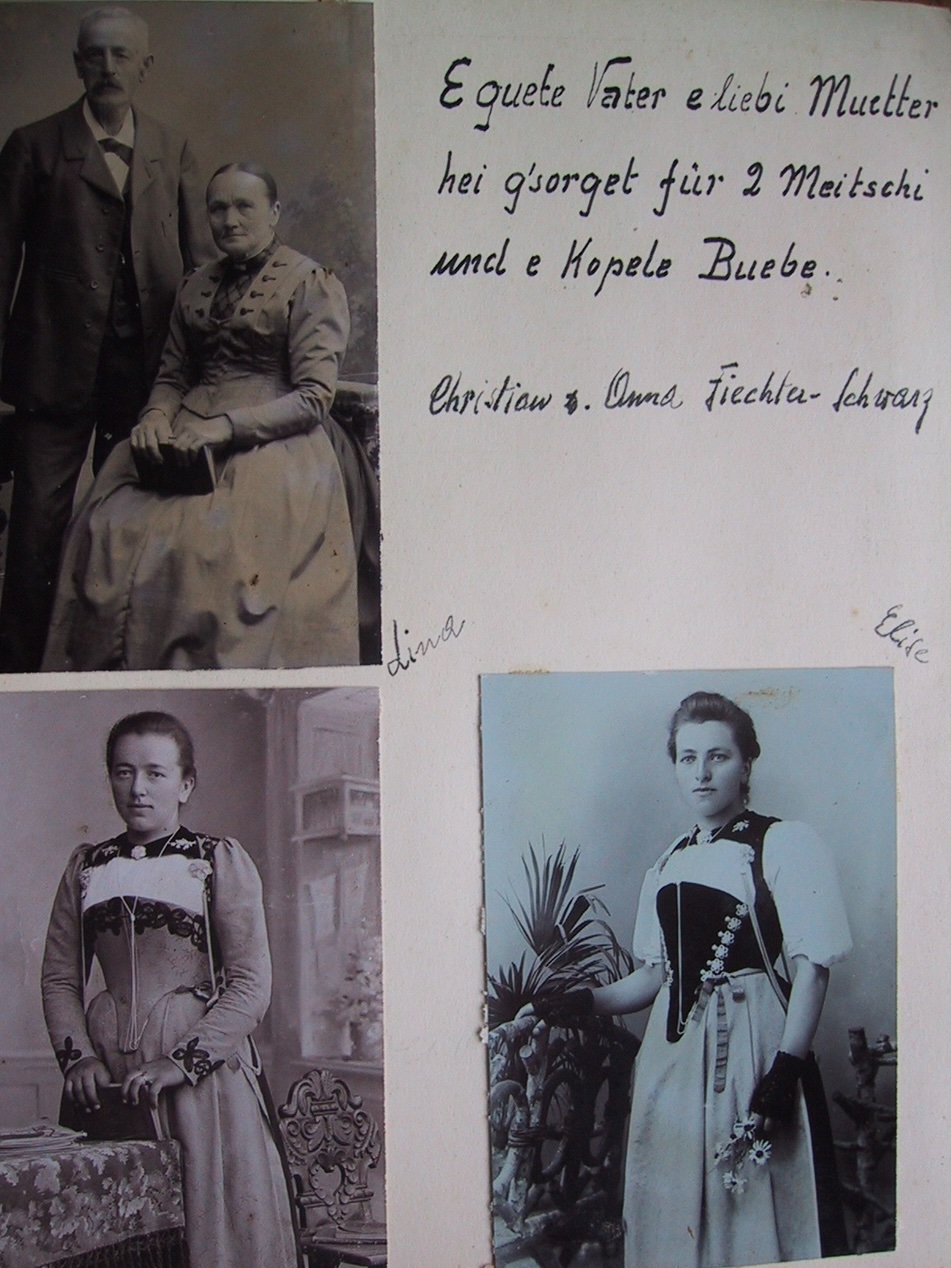
Indeed, Christian and Anna had 14 children, two daughters and 12 boys. Below are the details obtained through Hedwig (Hedi) Fiechter in connection with the Fiechter gathering she organized in Suhr on May 30, 1979 for the cousins.
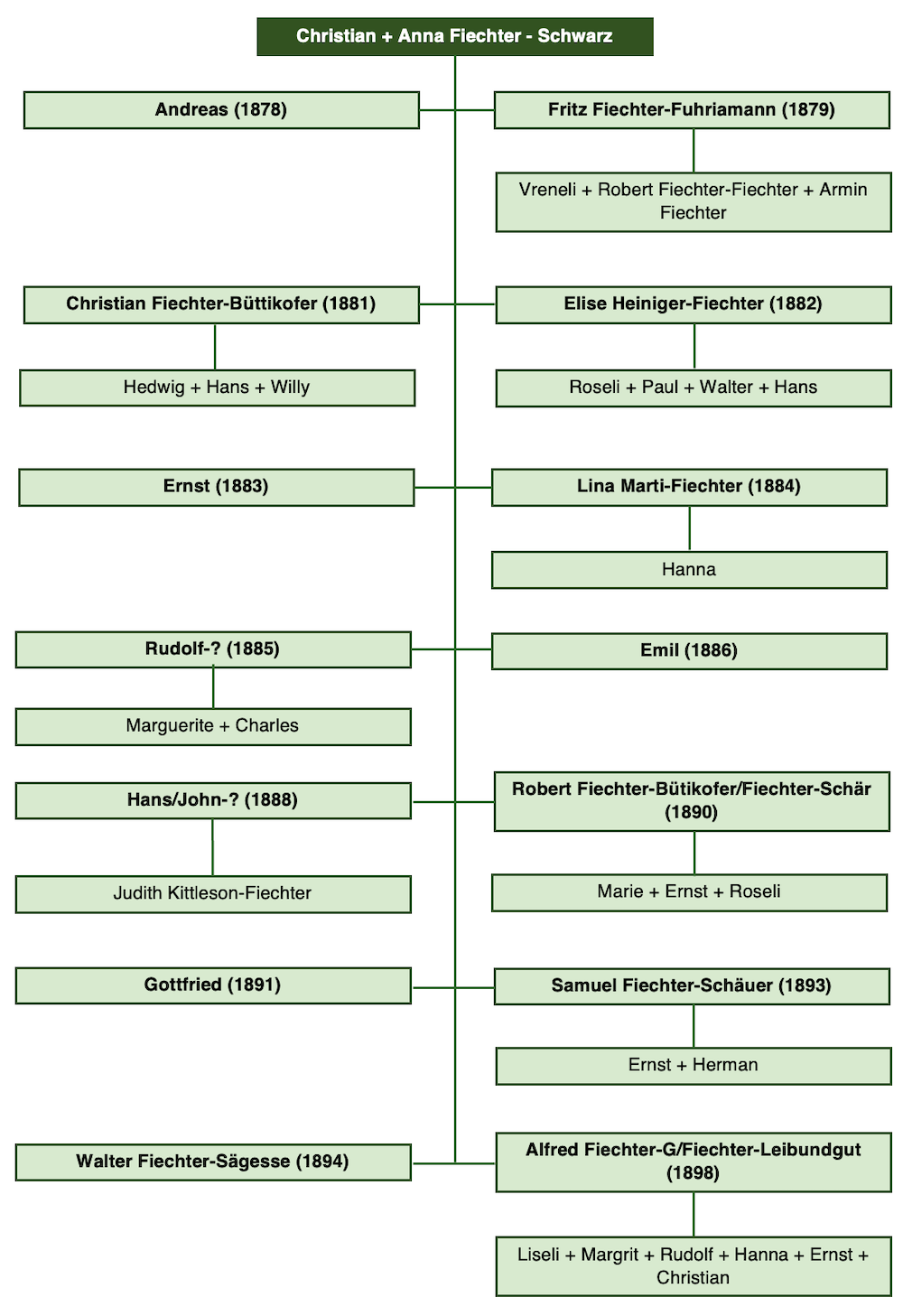
The children of Christian and Anna had only few children, not more than four and now in the 21st century, most of their descendants have no children.
While most children of Christian and Anna remained in the region of origin, within the Canton (state) of Bern, some moved east to other cantons while others left for America. One generation later their descendants travelled across the world for education or work but most returned ultimately to Switzerland reflecting the higher standard of living reached across Switzerland.
In the list of children it is easy to see if women were married because they had their husband's family name added before their own. Today in 2025, chaos prevails since the partners have more choices available regarding their family names, but the old habit has not disappeared completely, assuming they still marry, which usually happens only, if and when they have children.
In the list below, the letters in brackets refer to the canton / state where the locality is situated. The abbreviation list of all Swiss Cantons/states can be found under https://en.wikipedia.org/wiki/Cantons_of_Switzerland
The list below includes the sons and daughters of Christian and Anna and their grandchildren as well as their great-grandchildren when known.
Details will be provided under a separate section for the great-great-grandchildren of Christian and Anna, born more than one hundred years after Christian and Anna.
- Andreas Fiechter 1878 in Kaltenegg as spelled in German or as spelled in Bernese: Chaltenegg.
- Fritz Fiechter 1879 married to Elise Fuhrimann, in Ramiswil (S0). She had one daughter, Vreneli Fiechter. Fritz and Elise also adopted Robert Fiechter-Fiechter, in Untersteckholz, since 2010 part of Langenthal. Armin Fiechter (1924–2010) was microbiologist and professor at the Polytechnic in Zurich.
- Christian Fiechter 1881 married to Rosa Bütikofer, in Suhr (AG)
They had three children, Hedi Fiechter, in Burgdorf and later in Suhr, Hans Fiechter-Hunziker in Aarau and Willi Fiechter-Lötscher in Geneva. Hans married Betty and they had three children, Christian, Myriam and Hansueli Fiechter in Aarau. Christian married Amalie and they had two children, Christian and Richard, living in Aarau (AG). Willi Fiechter-Lötscher, married Martha, and they had four children, Eric Fiechter-Widemann, Evelyne Fiechter, Robert Fiechter-Vassiliadi, living in the Republic and Canton of Geneva and Isabelle Hämmerli-Fiechter living in Suhr (AG). More about them under a separate section below. - Elise Fiechter 1882 married to H. Heiniger, with four children Roseli Bütikofer-Heiniger in Hälfligen, near Dürrenroth (BE), Paul, Walter in Rosshäusern and Hans.
- Ernst Fiechter 1883 in Kaltenegg.
- Lina Fiechter 1884 married to Fritz Marti in Sumiswald with one daughter Hanna Flückiger-Marti living on the farm Steckholz in Sumiswald, with two children, Ueli and Therese
- Rudolf Fiechter 1885 married in the USA. He had two children, a son who passed away and a daughter. Rudolf Fiechter came to the US in the early 1900's and settled in New York as a chef at the Waldorf-Astoria Hotel and /or at the Plaza Hotel. He married a French lady and had two children, Marguerite and Charles. Charles died in WWII while serving in France. Marguerite married and had a son and daughter.
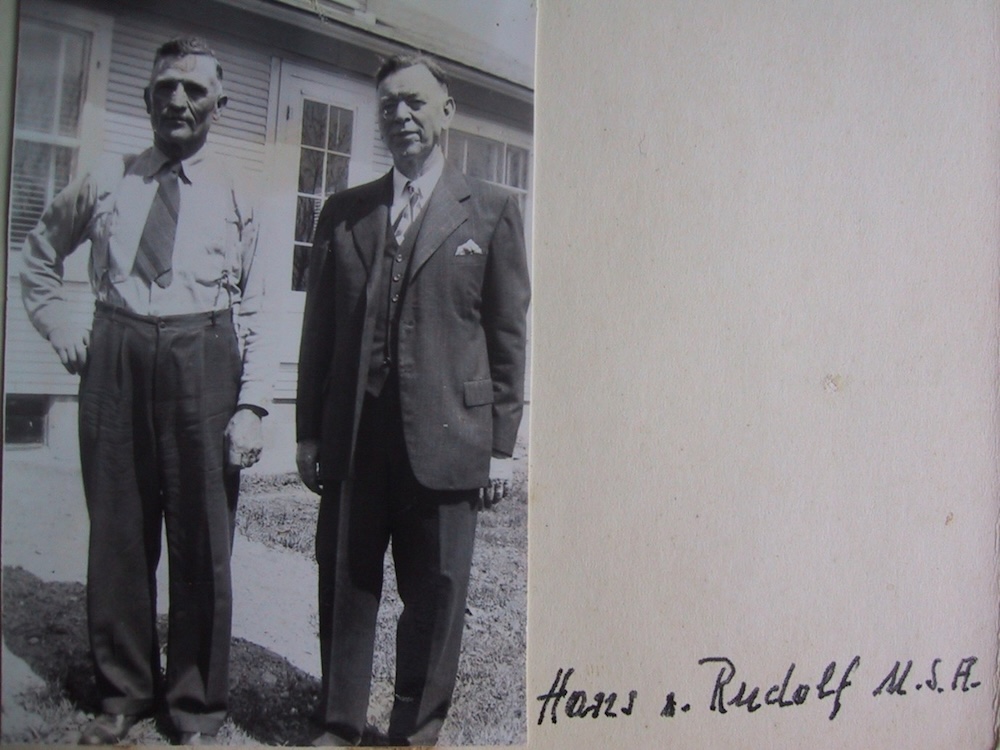
- Emil Fiechter 1886 lived in the USA.
- Hans (John) Fiechter 1888 is said to have had four children in the USA. His Daughter Judith Kittleson-Fiechter visited Dürrenroth, Chaltenegg and the region. She and her husband Richard had a daughter, Amy and a grand daughter, Mary and a son, Gary who married to Janice.
- Robert Fiechter 1890 was married to Elise Bütikofer from Kernenried (BE) and later was married to Marie Schär, Kaltenegg with three children Ernst Fiechter and Roseli Hess-Fiechter, in the Kaltenegg. Her daughter Hermine has five children.
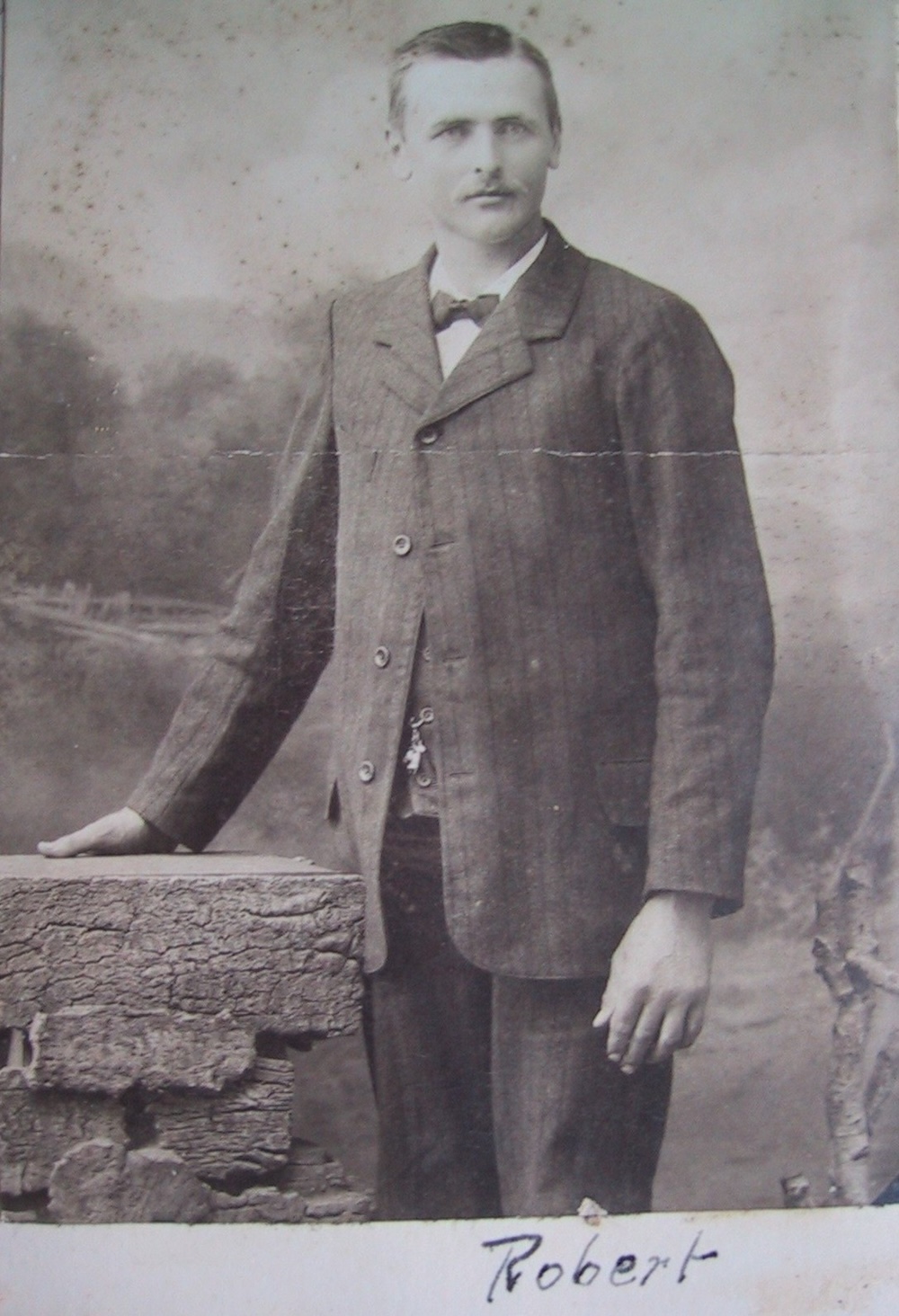
- Gottfried Fiechter 1891 in the Kaltenegg.
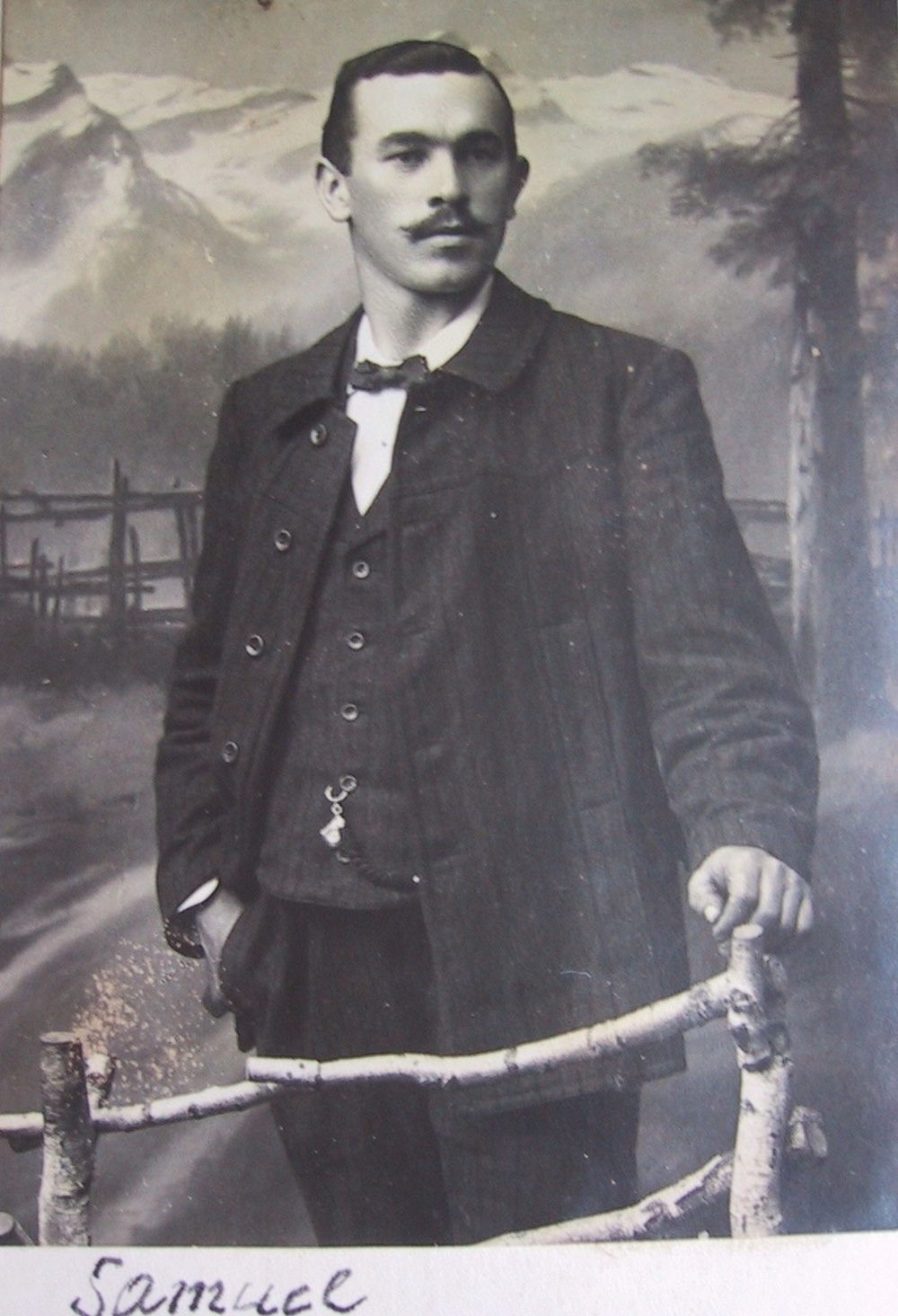
- Samuel Fiechter 1893 married to Emma Schäuer, in Melchenau with two children, Ernst Fiechter and Hermann Fiechter, also in Melchenau (BE).
- Walter Fiechter 1894 married to Frida Sägesse
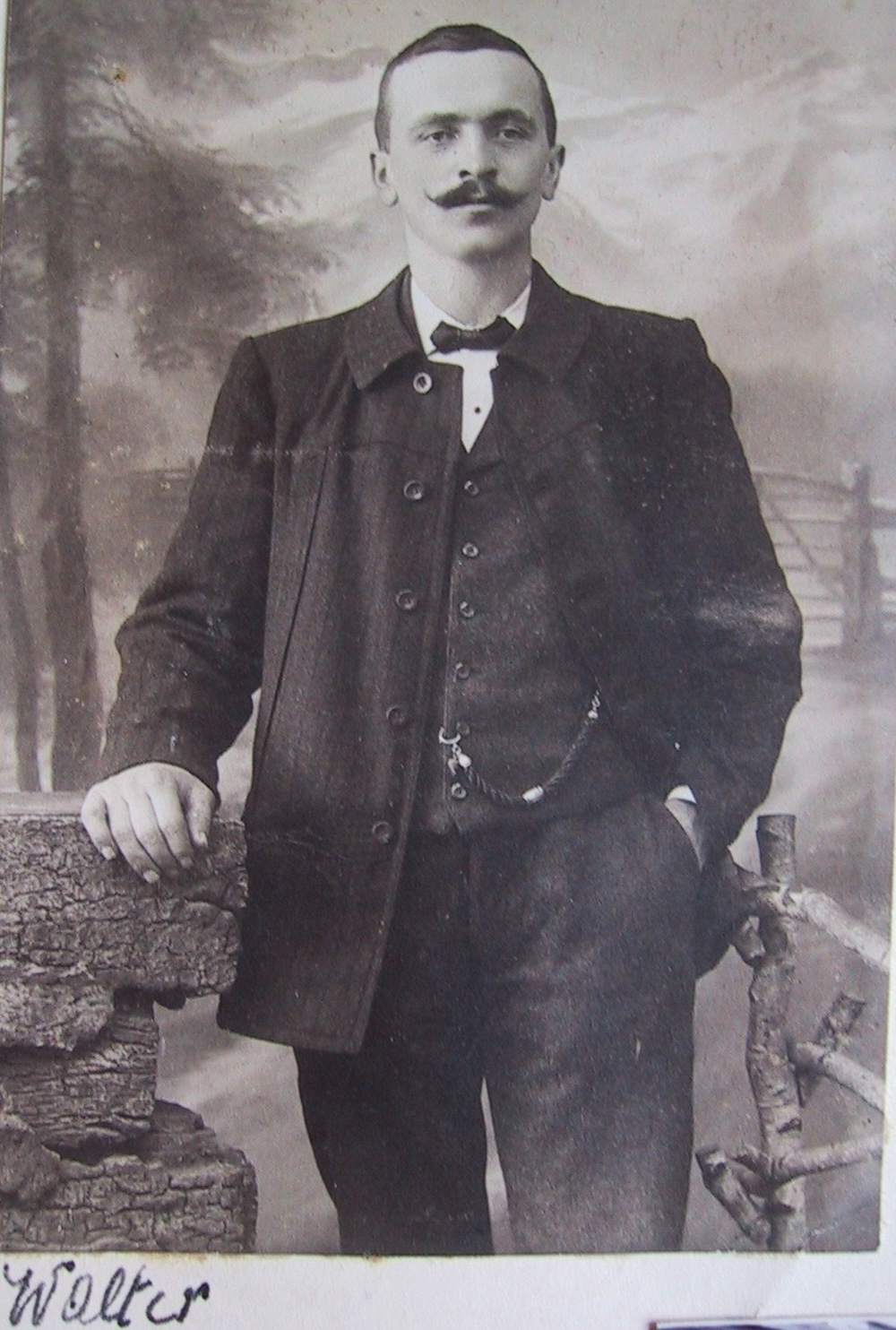
- Alfred Fiechter 1898 married to Greti G., then to Klara Leibungut with 6 children, Liseli Gygli-Fiechter in Ramiswil (SO), Margrit Widmer-Fiechter Oberrieden (ZH), Rudolf Fiechter-Bachung, in Attiswil (BE), Hanna Gygax-Fiechter in Aarwangen (BE), Ernst Fiechter-Mäder in Hindelbank (BE) and Christian Fiechter, in Schwarzenbach (BE)
Christian Fiechter and Rosa Fiechter-Bütikofer (AG (XIX and XXth Century)
This is the announcement of the birth of Christian Fiechter who married later Rosa Bütikofer
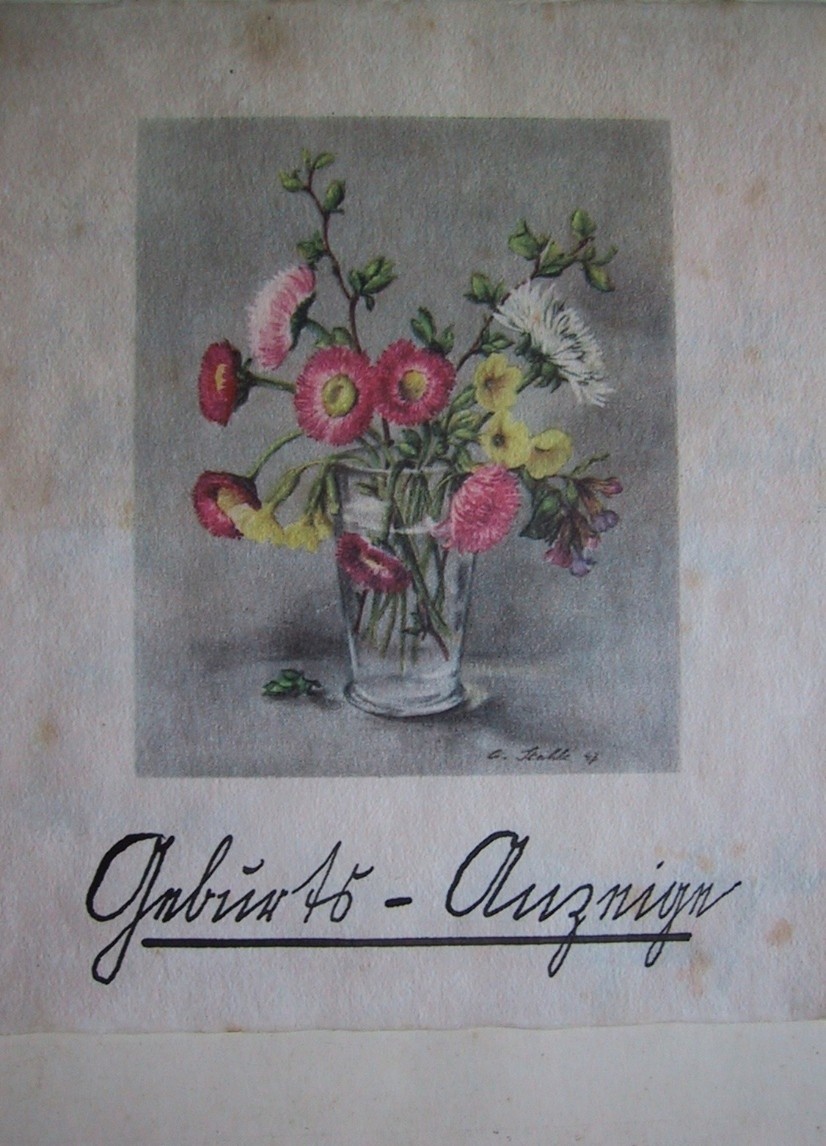
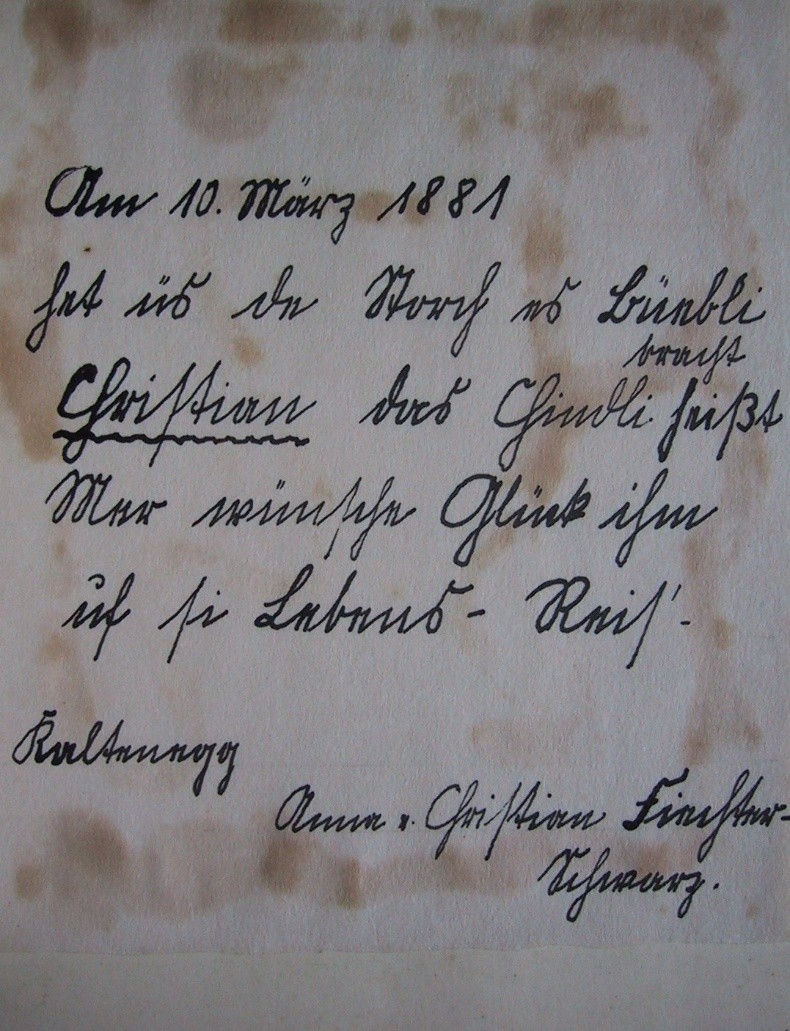
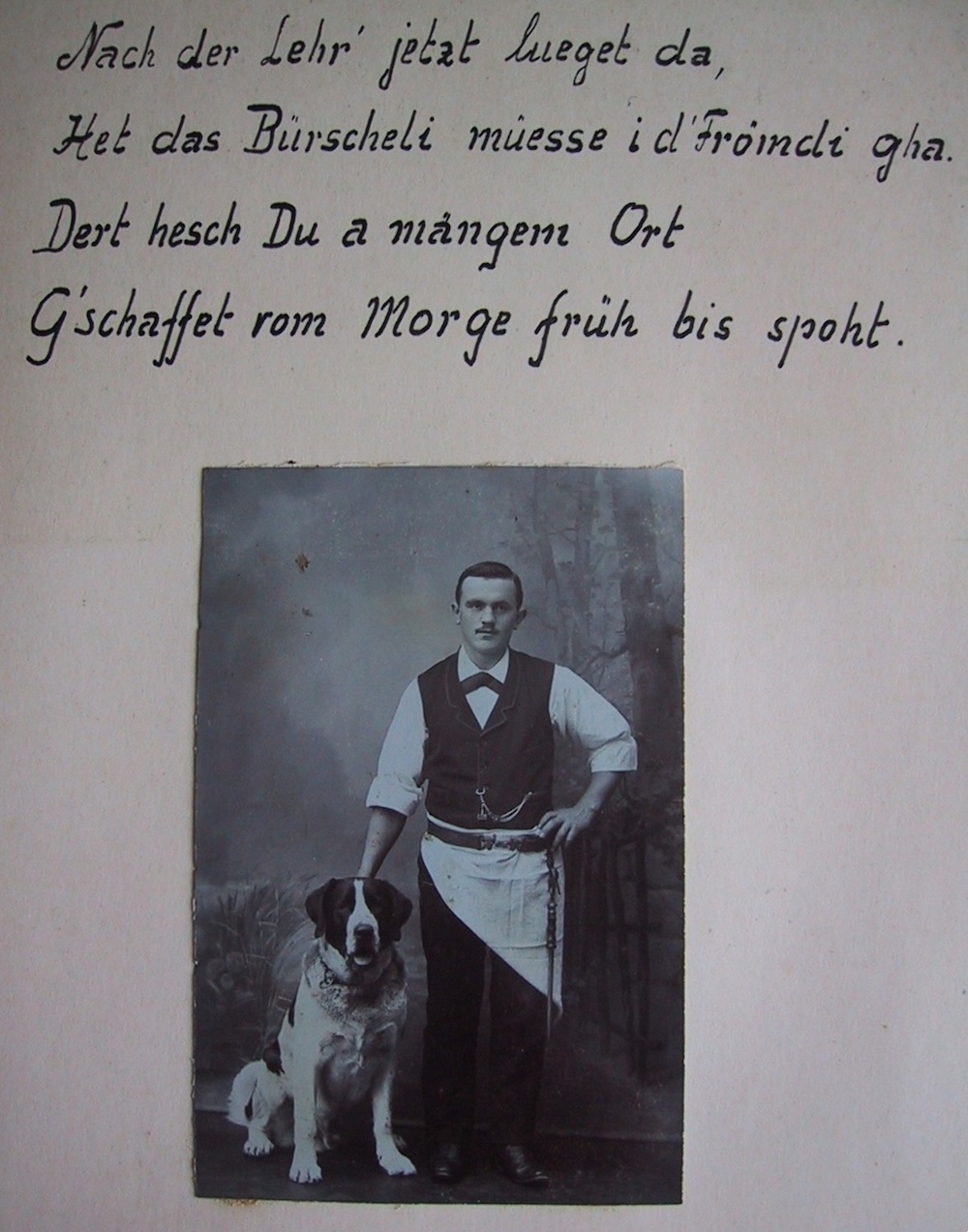
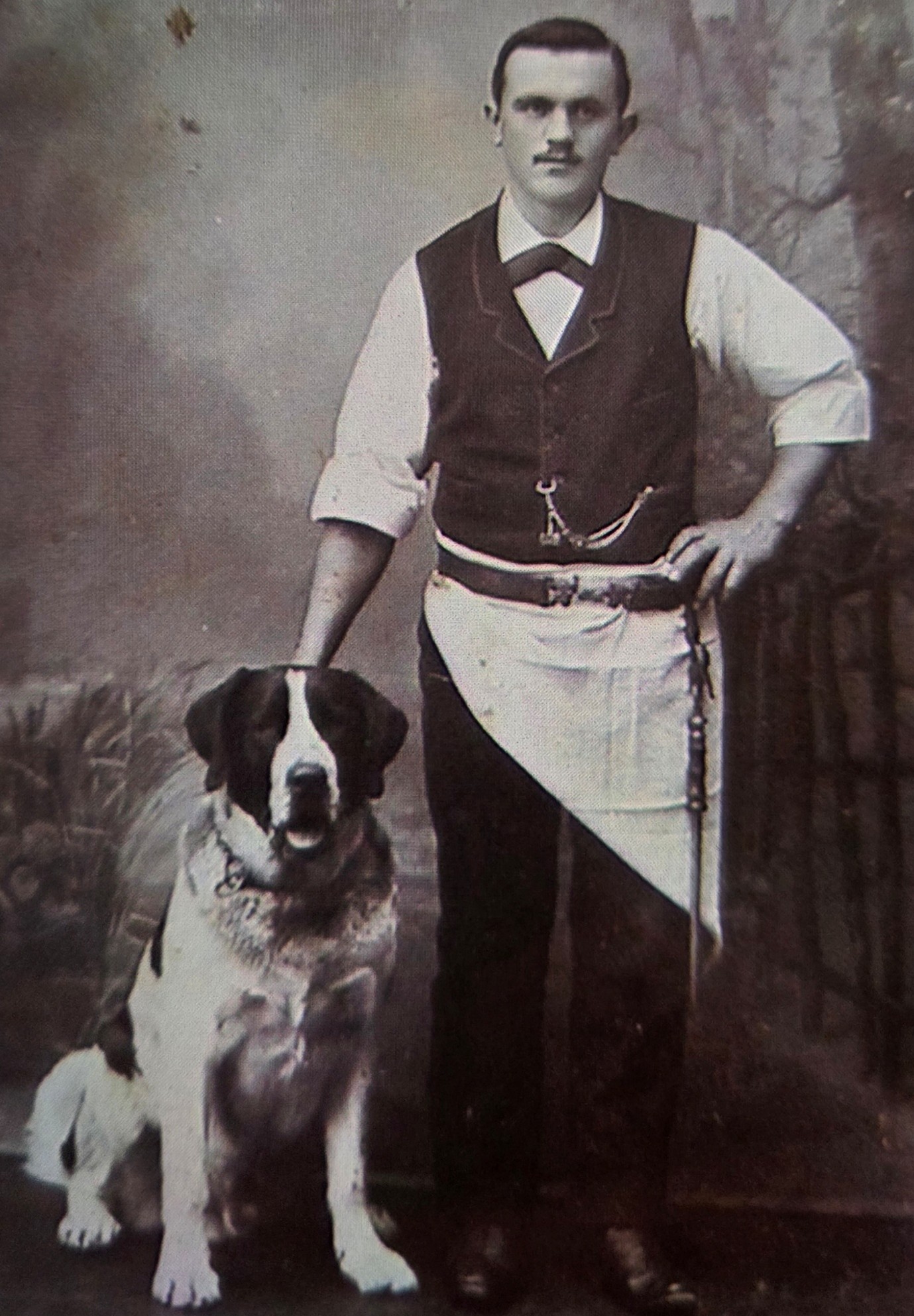
Under Bernese inheritance law, the youngest boy inherits the parent's farm. Christian Fiechter not being the youngest, he had to learn a trade. He became a butcher in Dürrenroth.
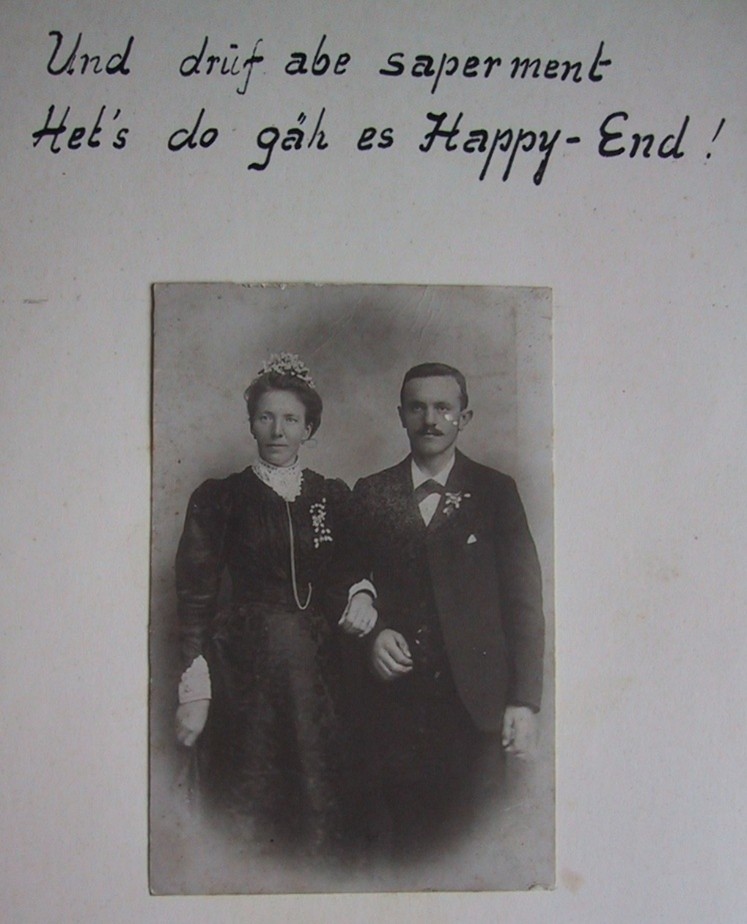
After having completed his formation Christian Fiechter married Rosa Bütikofer.
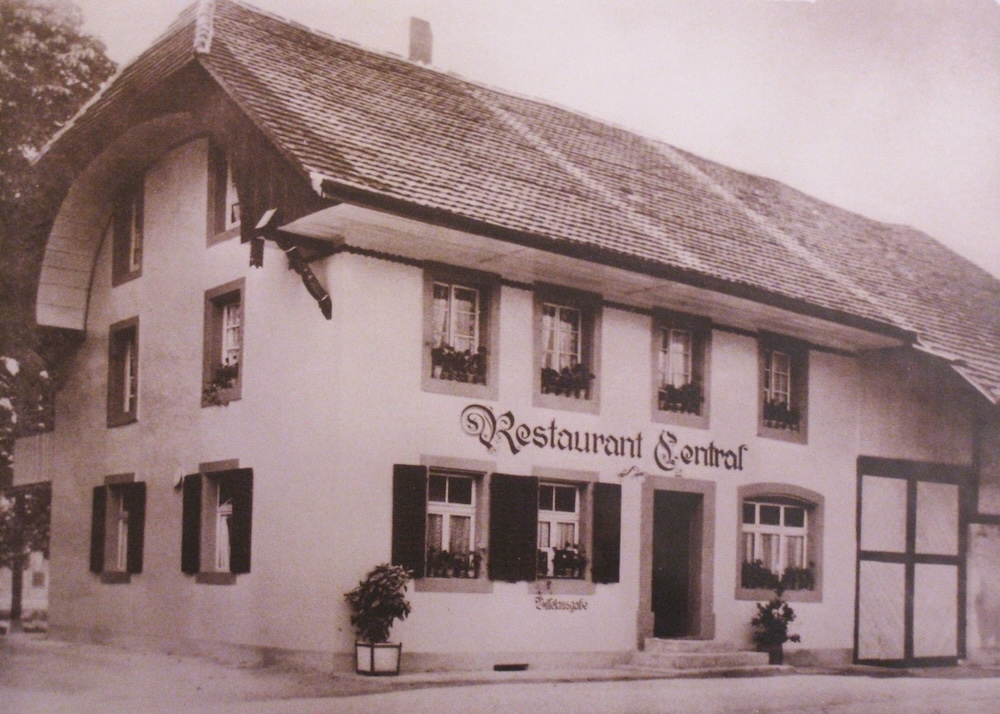
After leaving Dürrenroth where he did his apprenticeship as a butcher Christian took over the Restaurant Central in Suhr (AG). The building has since been replaced and the local train, for which he also sold tickets, has been moved to a faster route, separated from the road.
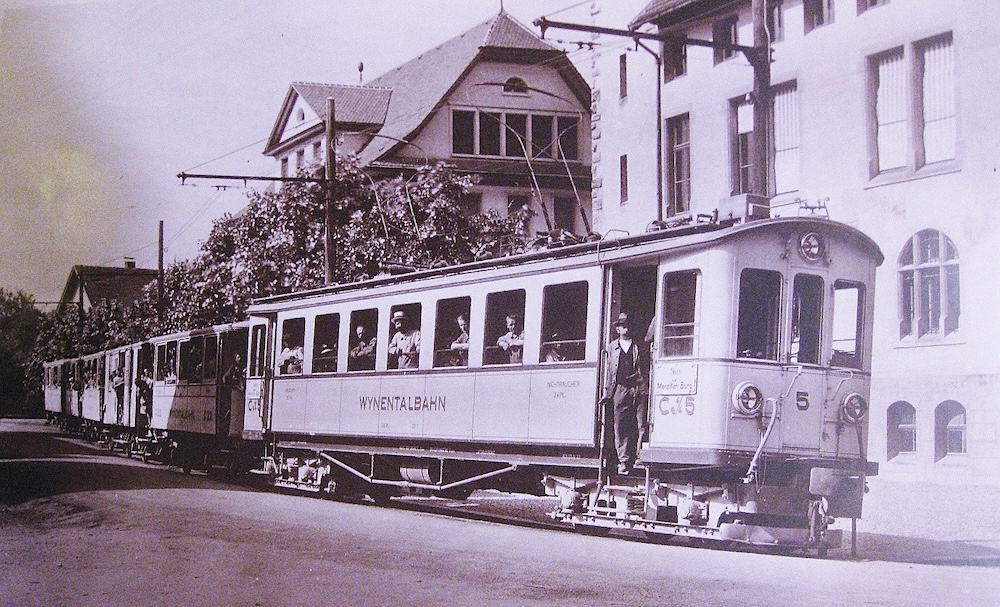
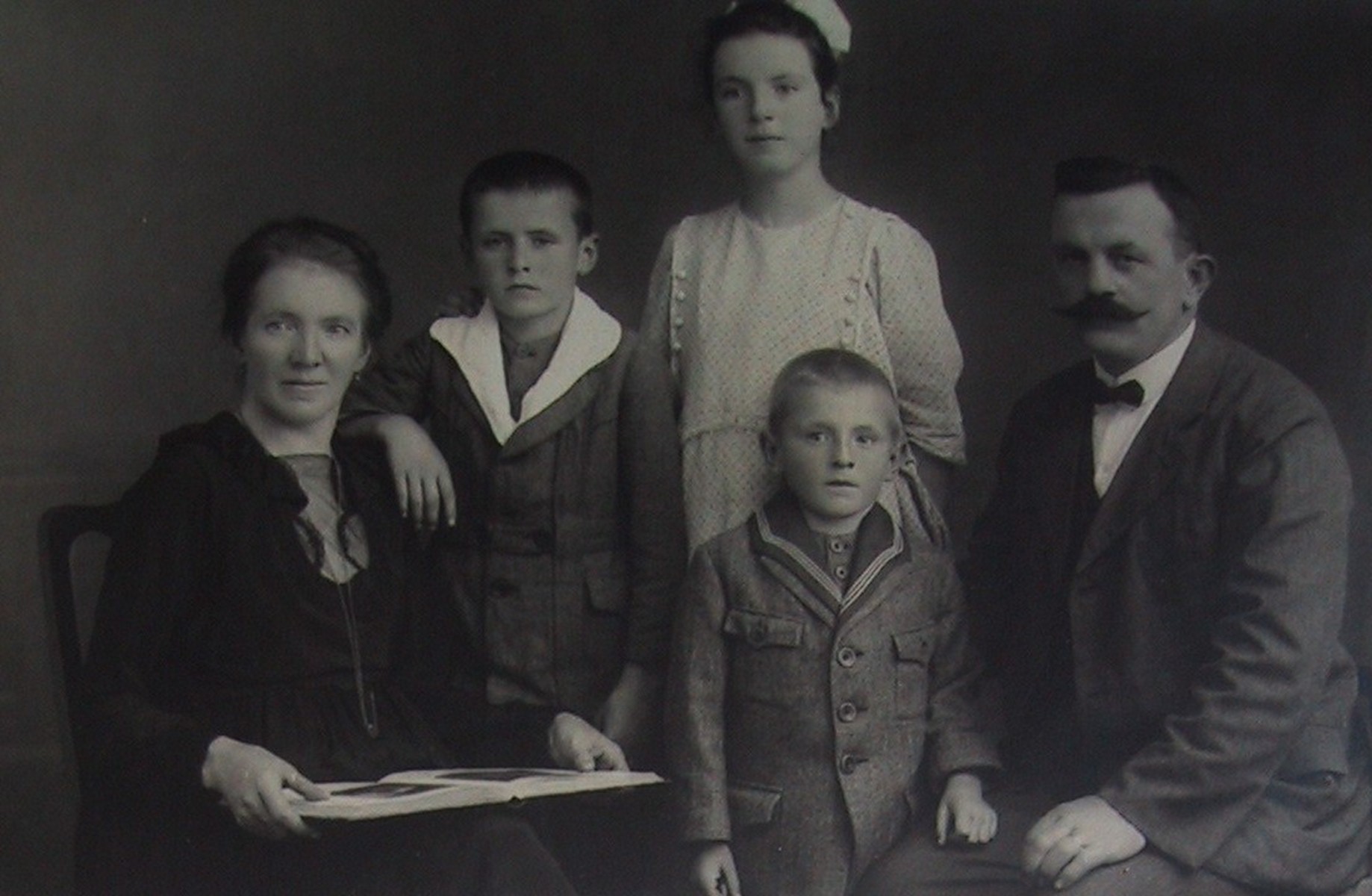
Suhr is the village where Christian and Rosa raised their three children Hedwig (Hedi), Hans and Willy.
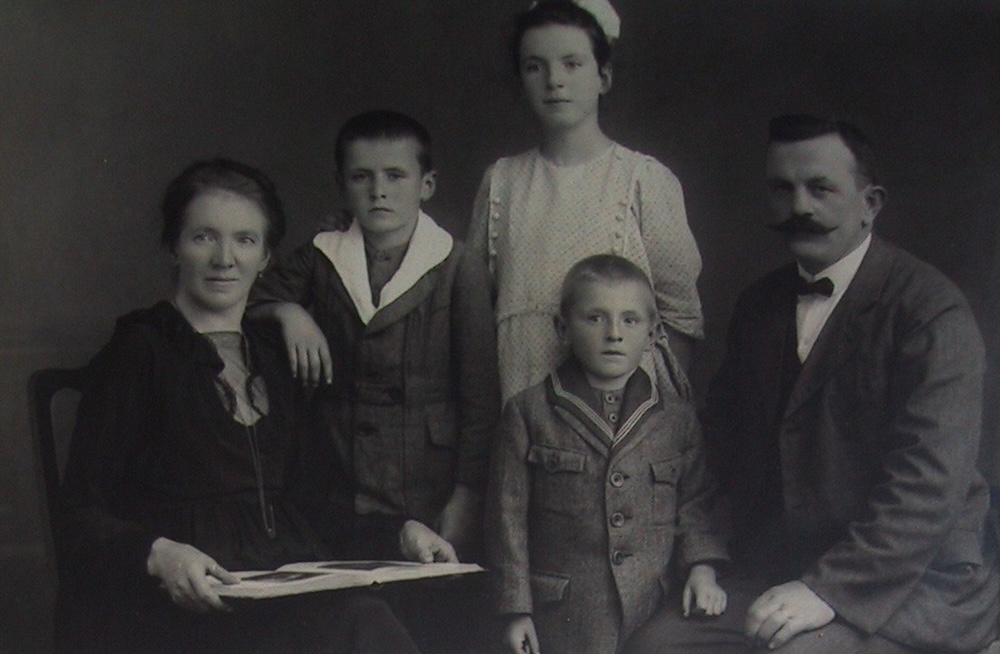
Hedwig (Heidi) never married. She was a teacher in Burgdorf (BE). Hans married Betty and they had three children. Myriam died before she was 20, Christian married Amalie (Anny) and they had two sons Christian and Richard, not married. Hansueli, married Suzi and they had a daughter and a son. Willy married Martha. They had four children in Geneva and nine grand-children.
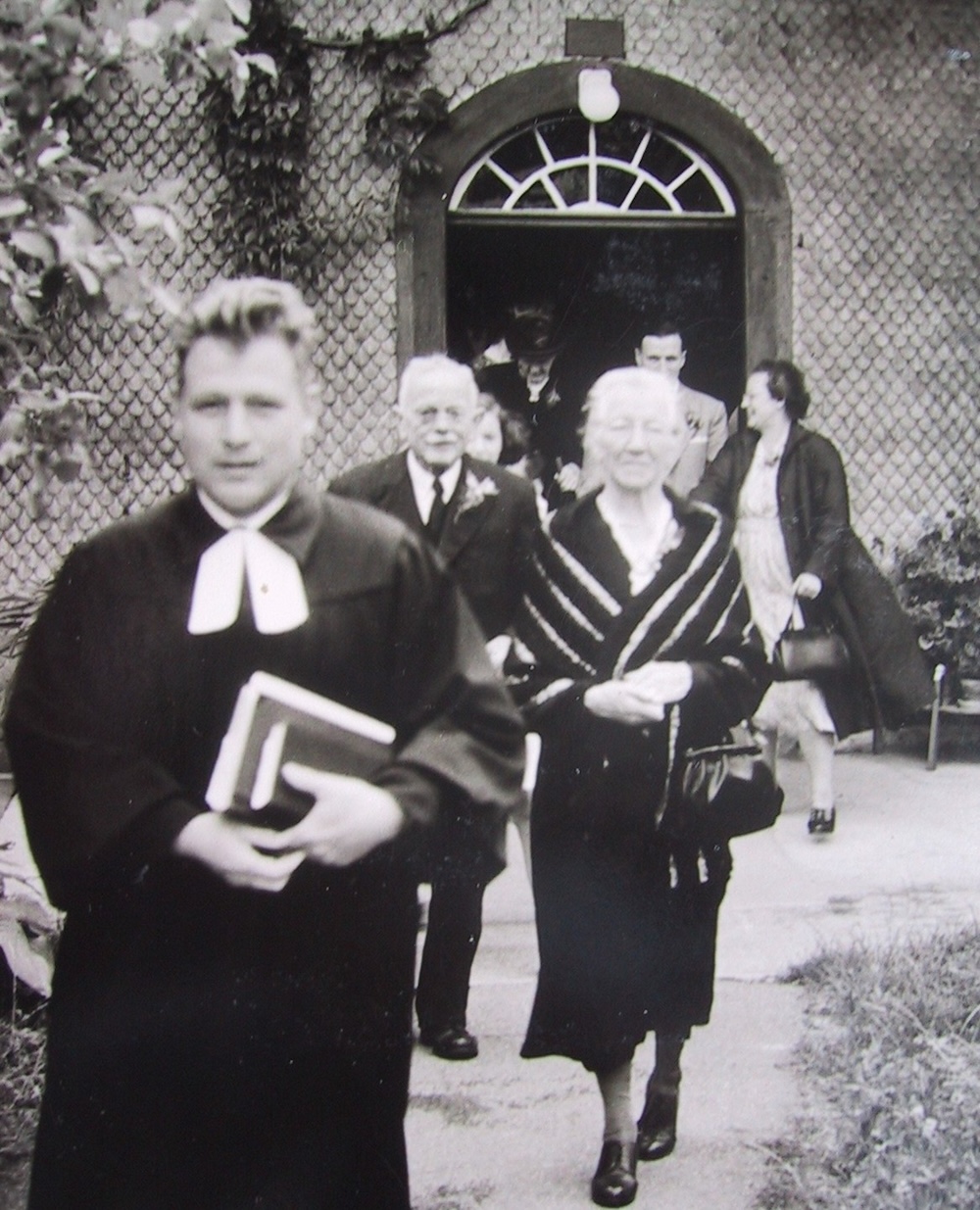
Christian and Rosa Fiechter-Bütikofer lived long enough to celebrate their 50th wedding anniversary in Affoltern i.E.
Christian and Rosa, happily retired in the house still inhabited by Isabelle Hämmerli-Fiechter and her family in Suhr (AG).
Of the three children of Christian and Rosa, Hewig was the oldest. On this picture she can be seen with her two brothers Hans and Willy.
Hedwig, or Hedi as she was called, became a school teacher for nutrition and household management, teaching first at the school in Herzogenbuchsee, where she met Lina Bögli a woman who had travelled alone to Japan, China,New Zealand and Australia to name just a few, at the end of the XIXth century, at a time when no woman travelled alone like that! Her book about this trip was published again in 2019.
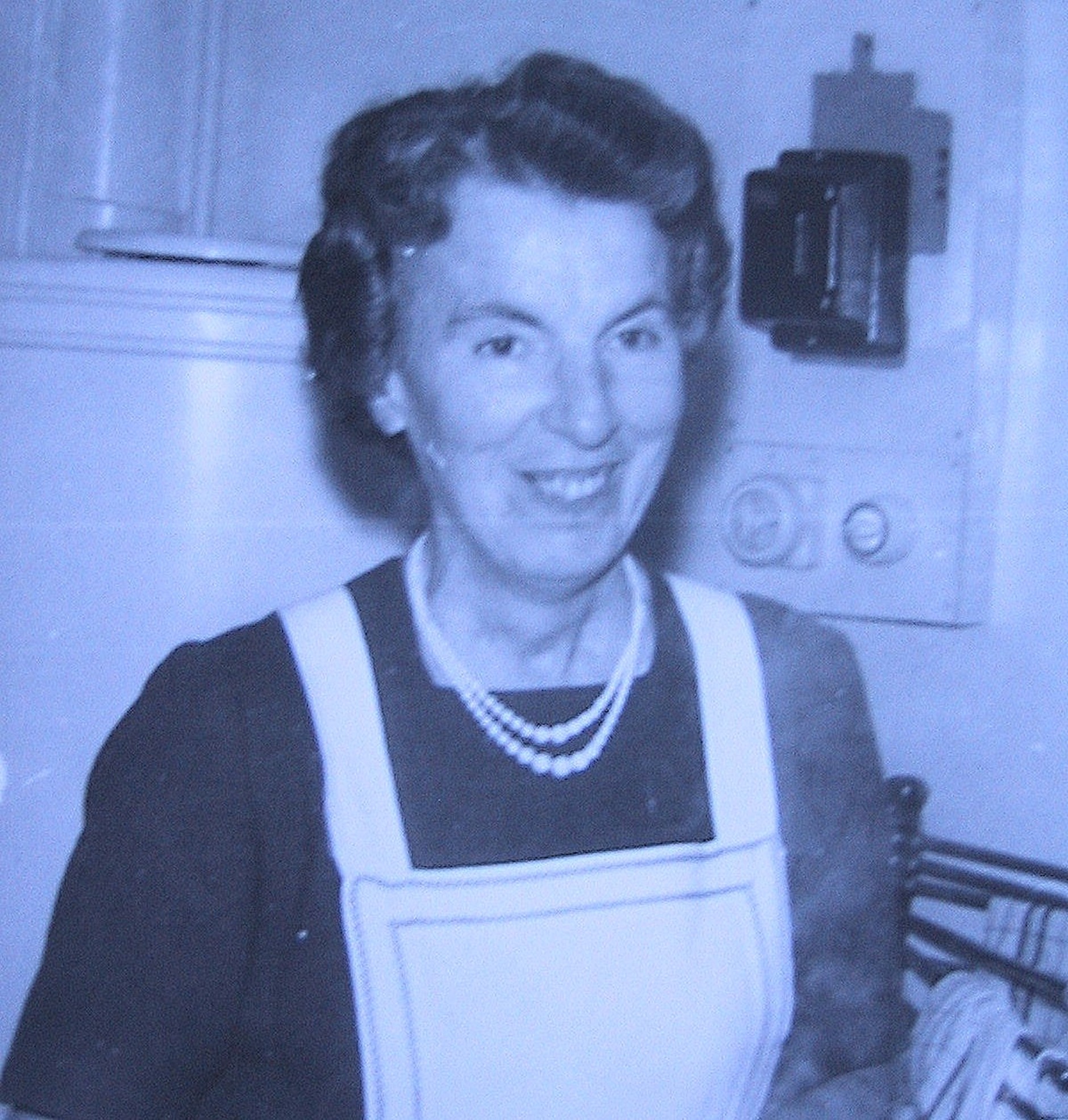
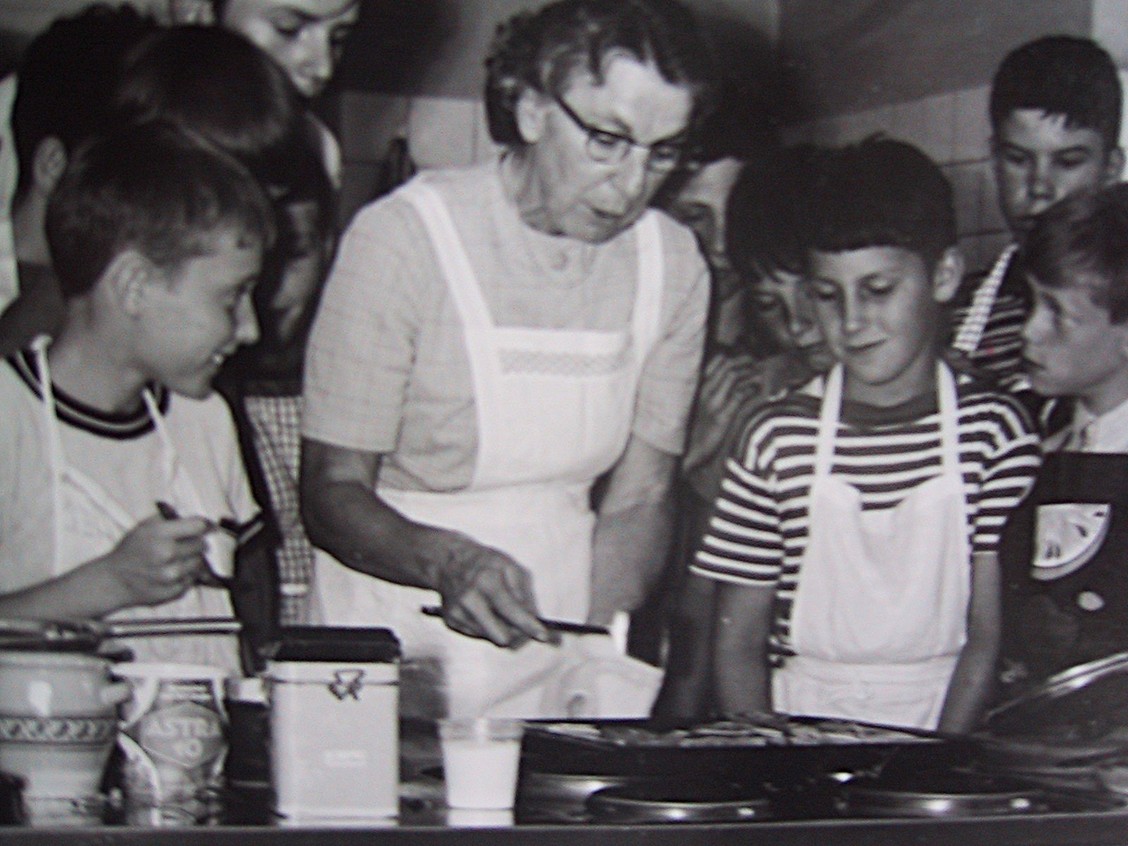
Hedi's next and lifelong teaching assignment was in Burgdorf, where she continued teaching beyond retirement age. She was well known throughout the Emmental, having taught so many girls and boys over the years the secrets of good and healthy cooking.
She finally retired to the house of her parents who had bought it for their own retirement in Suhr, after they sold the restaurant. Hedi never got married but she helped her lifelong all those in the family who needed assistance.
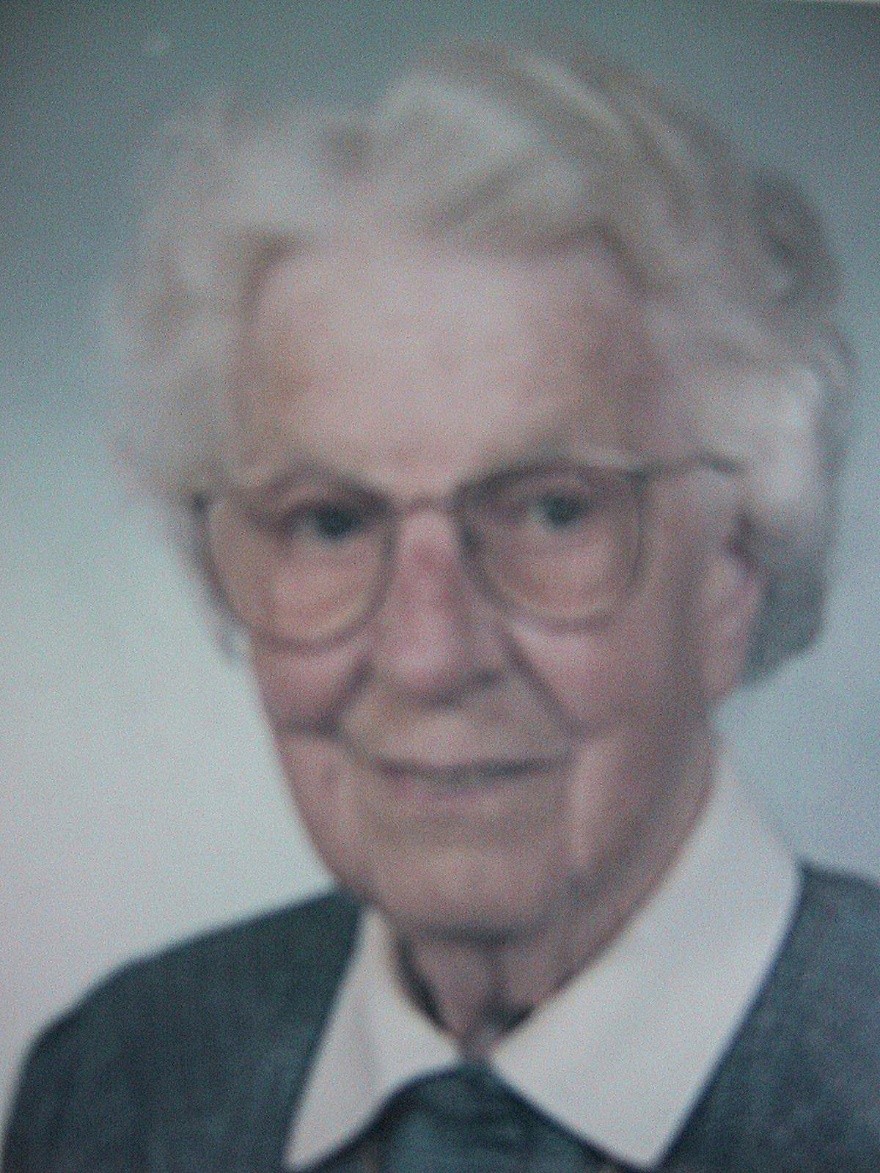
Hedi's brother Hans Fiechter-Hunziker married Betty and they owned a bakery in the old town of Aarau. They had three children, Christian Myriam and Hansueli. The son Christian had two sons, Christian and Richard still living in Aarau, but not married and without children. Myriam died as a teenager and Hansueli took over the bakery with his wife Suzanne and they had a girl and a boy who became himself father, but not more is known of them, and they lost the bakery.
Willi Fiechter-Lötscher, the youngest son of Christian and Rosa got his initial training in hospitality in Lausanne, to learn French. He also travelled to Stirling and worked as a chef at the Golden Lion Hotel to improve his English. Back in Switzerland he headed the Hotel Monopol in Lucerne during WWII.
Willi met Martha Lötscher, his future wife, at his parents' restaurant in Suhr, where she had been working before moving on to Ticino, the Italian speaking area of Switzerland. The choice of Martha as his wife was not approved by his family as she was from a family of very poor farmers, and Catholic, which for the affluent Protestants on Willi's side was not promising for the future. But his choice was non-negotiable. Martha was a hard worker and a good witty wife and became the mother of four children Eric, Evelyne, Robert and Isabelle.
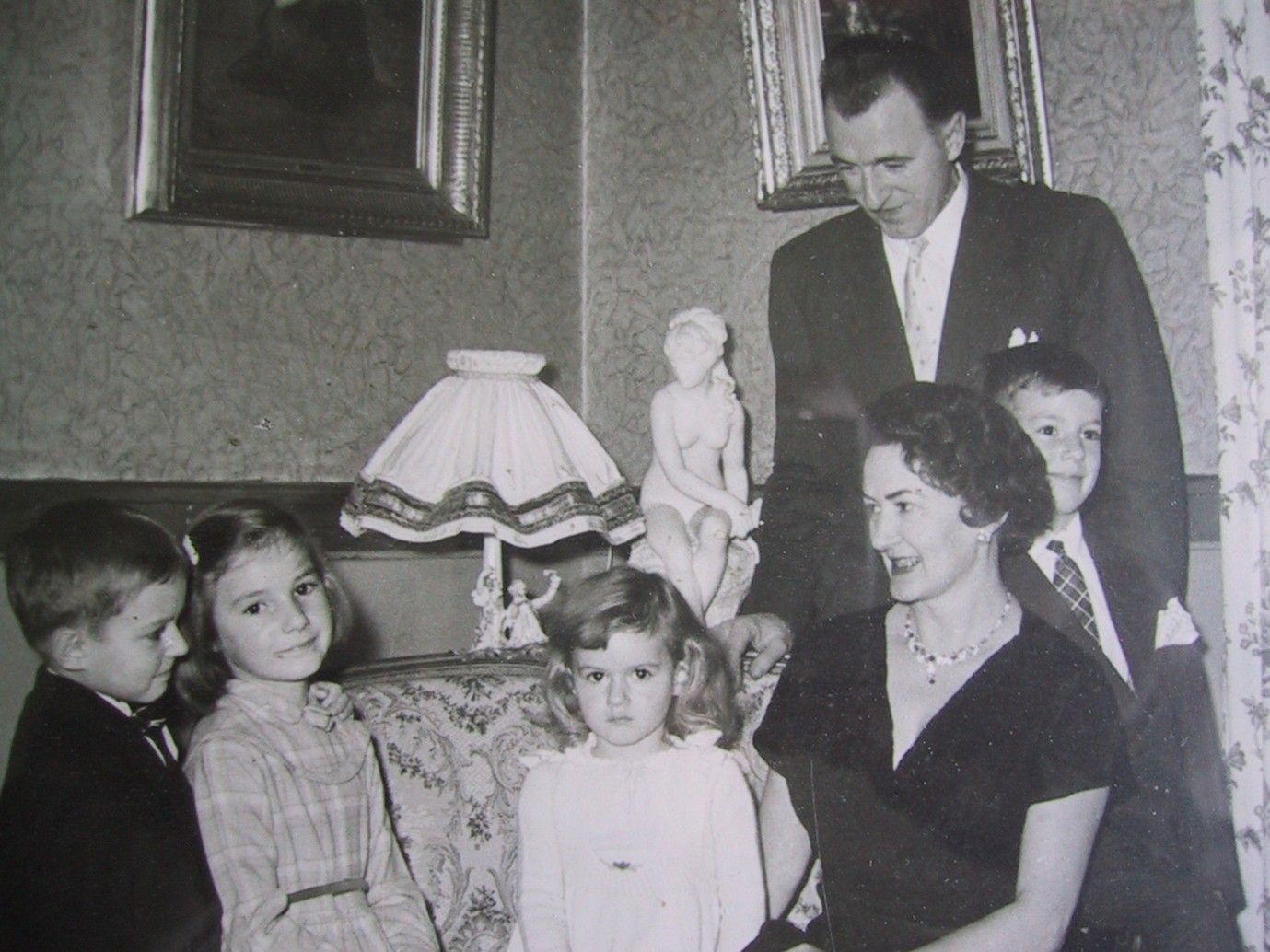
All together Rosa and Christian had a large family as can be seen on this picture where they stand in the middle, together with the young Myriam on the right, and Betty behind Rosa and Christian, and behind Betty, her husband Hans. Behind Christian and Myriam Prof. Werner Kägi and his wife Gertrud (Trudi).
Willy and Martha Fiechter-Lötscher (GE) XXth century
The childhood of Willy is described above under the section Christian and Rosa. Martha grew up in Malters (LU), with three brothers on a small farm. She wanted to become a medical doctor, but her stepfather was certainly not going to waste money on the higher education of a girl... So she became a waitress, which is how she met Willy.
After marring, Willy and Martha Fiechter-Lötscher hoped to take over a restaurant. They wanted to buy one in Basel https://www.schlossbinningen.ch/ but it was too expensive. With the help of Willy's parents, Willy and Martha finally bought a restaurant in Geneva just after the end of WWII: l'Or du Rhone, (The Gold of the River Rhone).
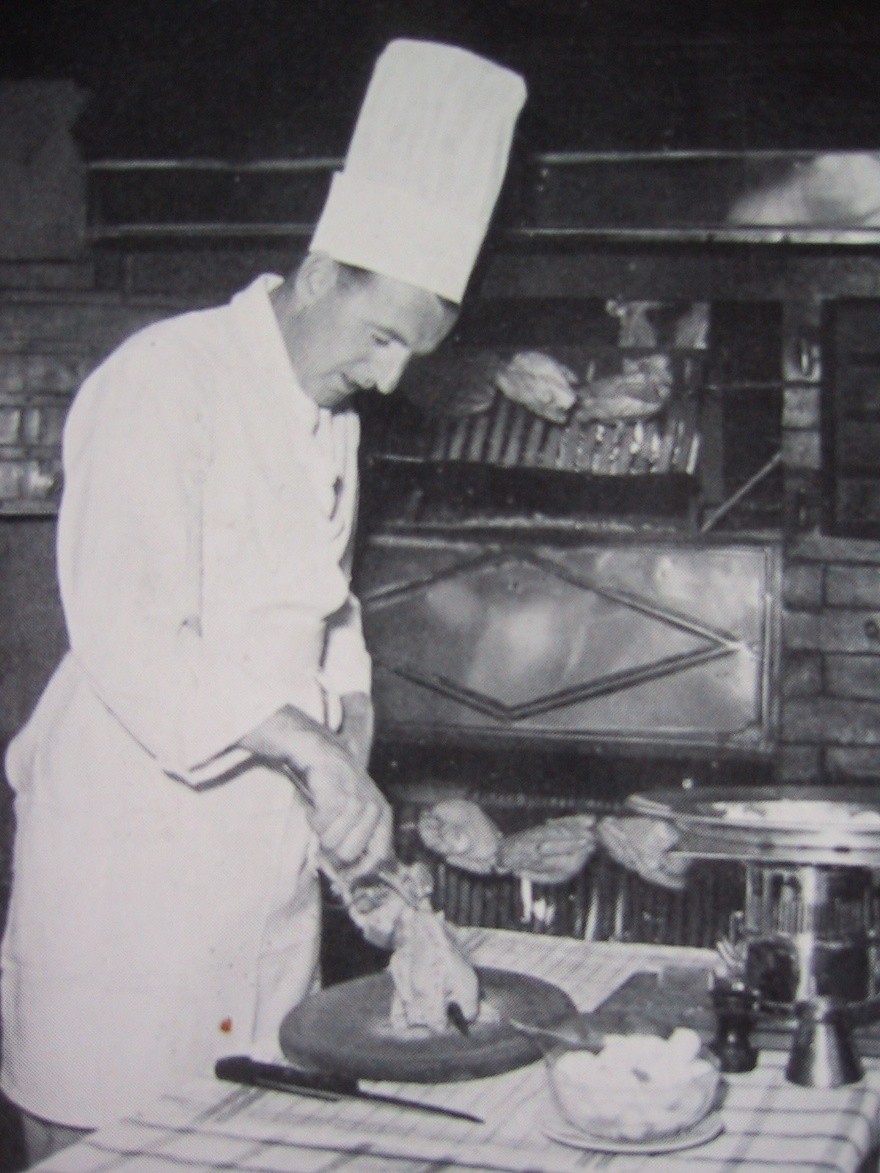
Willi and Martha worked in the restaurant until retirement age and welcomed the world dignitaries when they met for international conferences in Geneva. Religious dignitaries, such as the Aga-Khan, and numerous movie stars were also among their guests. The restaurant was mentioned in several US news reports in particular in the New York Times in an article of 1983 describing Geneva. Amazing how little things changed since the time the article was written!
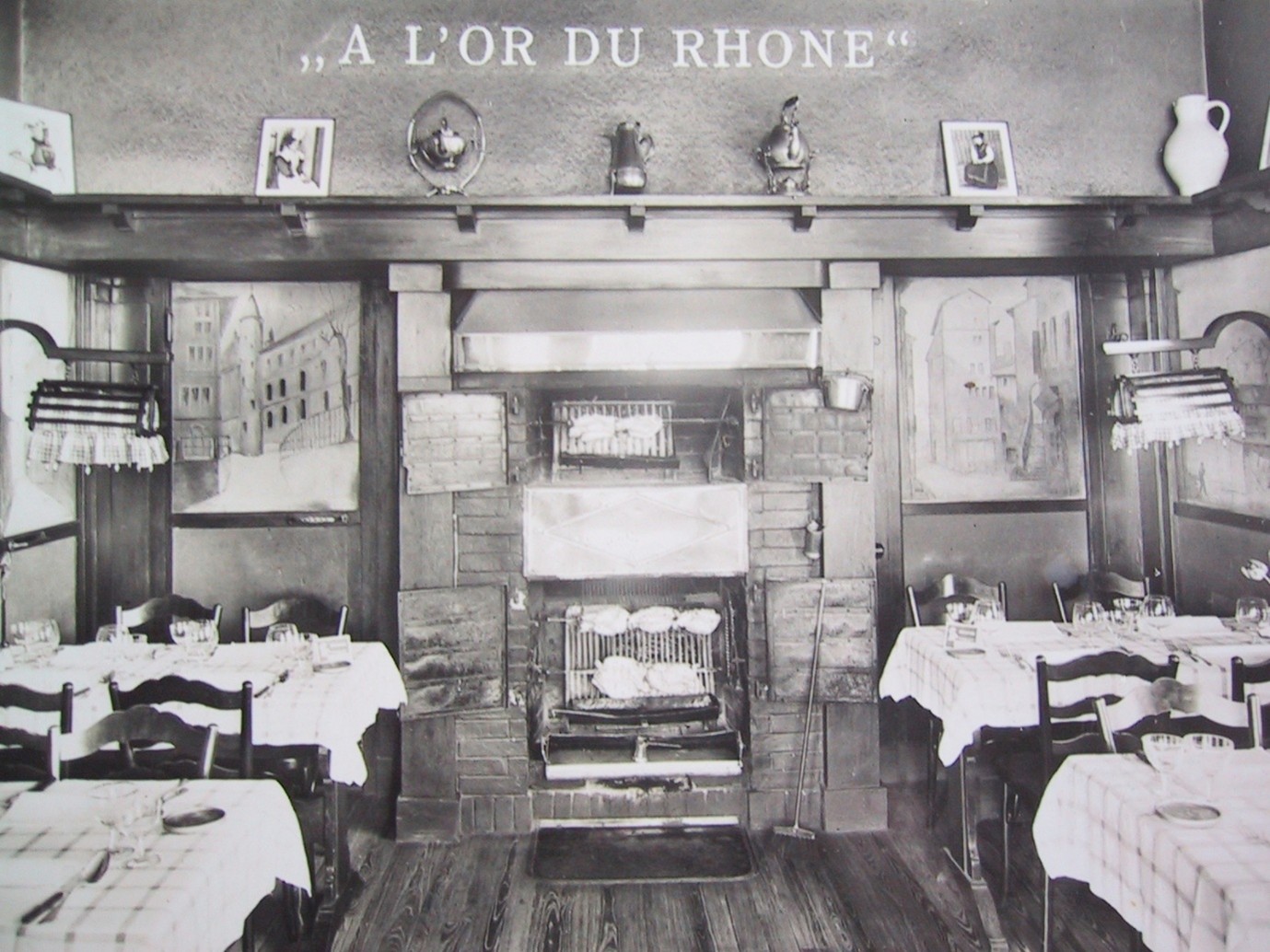
From the original location at Rue du Stand 46, they had to relocate to Place du Cirque / 19 Boulevard Georges-Favon, where their four children grew up, living in the banquet halls, which had been subdivided to accommodate the family, because of lack of available nearby housing facilities.
After retiring, Willy and Martha were quite busy with their 10 grandchildren.
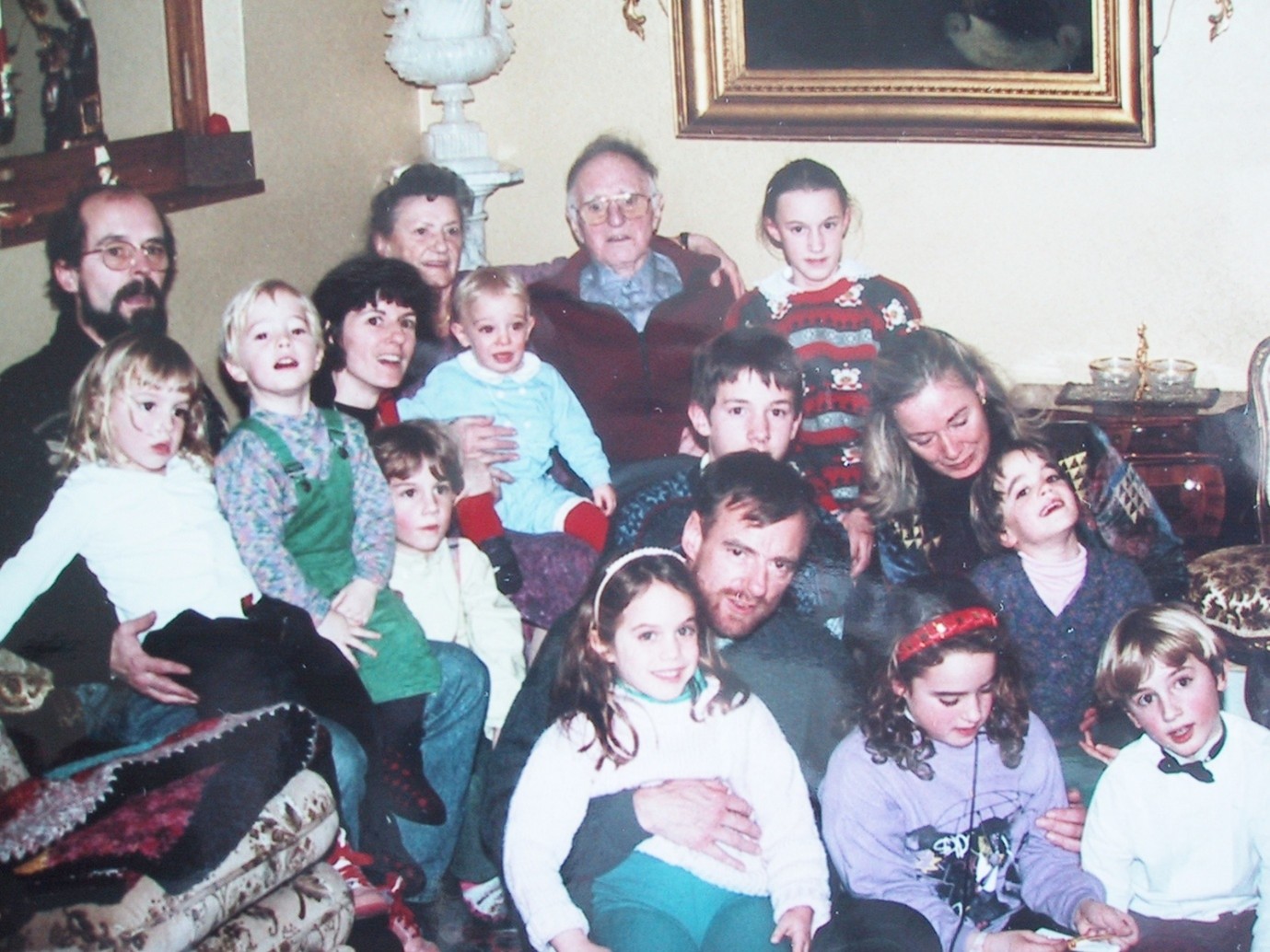
They had two from Eric and Evelyne Fiechter-Widemann, Jean-Rodolphe (in Bern) and Gwendoline (in Geneva), one from Evelyne and Roland Itié-Fiechter, Roland (in Geneva), four, from Robert and Julia Fiechter-Vassiliadi, Eva, Diane, Maxime and Cyril. Eva is married to Nizar Ghoula, with two boys: Eidan and Zain. Willy and Martha's youngest child, Isabelle married Michel Hämmerli-Fiechter. they have three children, David, Nicolas and Francois, all in Suhr (AG). David is married to Margot, with two boys, Leandro and Jeremy. More information about the Fiechter professionals can be found on the listed websites at the end of this summary.
The demographic evolution of the Swiss population is evidenced by the Fiechter Family. While the Fiechter-Schwarz had 14 children, the next generation had 5 at the most and the present generation has not more than two, with most without children at all.
There is presently not one Fiechter descendant from the Fiechter-Lötscher that carries the name "Fiechter" beyond the present generation!
What a change in just 100 years.
But of course, there are numerous other "Fiechter" living in Switzerland and abroad.
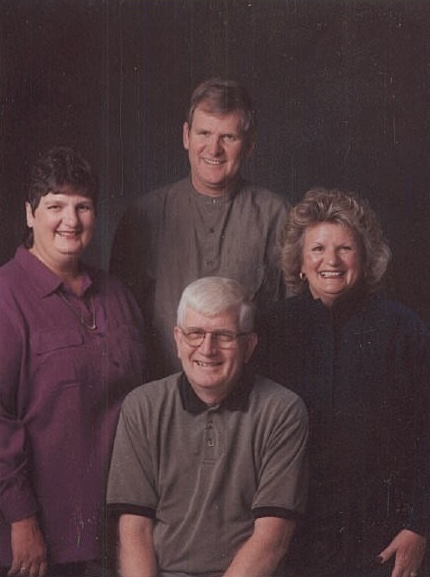
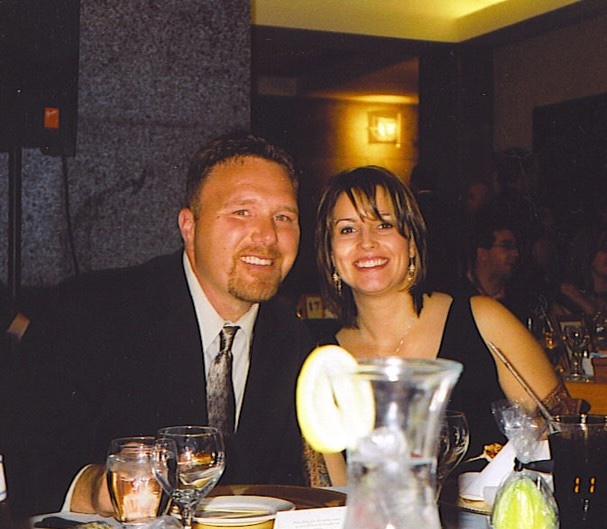
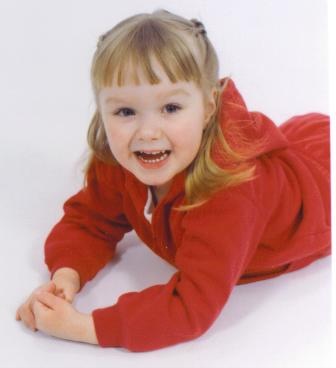
The descendants of Hans (John) Fiechter in the USA, Judith Kittleson-Fiechter
Links to other relevant websites
The websites where Fiechters can be found in 2026
desgouttes.ch
(Robert Fiechter)
fiechter.name
(Eric Fiechter)
secretantroyanov.com - liquidated in 2025
(Eric Fiechter)
asbs.sg - liquidated in 2025
(Eric Fiechter)
fiechter.name/firm/ W4W
(Evelyne Fiechter-Widemann)
abstiftung.org - liquidated in 2025
(Eric Fiechter) Belegungsanzeige
(Evelyne Fiechter-Widemann))